Winners Never Quit Unless They Want a Bigger Salary

Tuesday morning news drop

  • Winners never quit — unless they want to see a bigger salary increase. Research has found that “Quitters” earned higher percentage wage gains than those who stayed in their existing jobs. The average salary boost employees receive when changing jobs is between 10 per cent and 20 per cent, according to Forbes. Regardless of the absolute level, the underlying is sound: Employers looking to hire have had to raise salaries to attract workers. This not only leads to job switching within a given industry but has also led to career changes, as workers upskill and switch fields to have more lucrative careers. This also explains in part why so many low-skill, low-wage positions have gone unfilled. Whether they're looking for a change for better quality of life or pay, job seekers in Canada appear to have the upper hand amid the labour shortage seen in the country. (Global News)

  • The Great Resignation has employers sweating. It’s time to escalate the pressure This is a once-in-a-generation ‘take this job and shove it’ moment – which gives workers an upper hand. Let’s demand better hours, pay and work-life balance (Guardian)

  • Make Learning a Part of Your Daily Routine In our increasingly “squiggly” careers, where people change roles more frequently and fluidly and develop in different directions, the ability to unlearn, learn, and relearn is vital for long-term success. It helps us increase our readiness for the opportunities that change presents and our resilience to the inevitable challenges we’ll experience along the way. Adaptive and proactive learners are highly prized assets for organizations, and investing in learning creates long-term dividends for our career development. Based on their experience designing and delivering career development training for over 50,000 people worldwide, the authors present several techniques and tools to help you make learning part of your day-to-day development. (Harvard Business Review)

  • Porch Cameras and Facebook Groups Are Turning Streets into Surveillance States Our tech-driven approach to neighbourhood watch is cementing community divisions (Walrus)

  • How to Think About the Covid Recession This was a recession like no other in recent memory. The pandemic downturn was driven by all those industries that are supposed to be recession-proof — trips to the dentist, electricity usage in offices and malls, and so on. And the normally countercyclical education sector had big enrollment drops despite the bad economy. (New York Times)

  • The timing of the next global depression is getting closer than you think John De Goey: We will be in for a world of hurt as soon as government deleveraging begins (Financial Post)

  • The Intrinsic Futility of ES(G) Investing As predicted by financial theory, stocks of companies with positive environmental, social, and corporate governance (ESG) records underperformed the market. But the problems for ESG investors don’t stop there. Worst of all, ESG funds underperformed the non-ESG funds run by the same managers. (Advisor Perspectives)

  • Shipping is broken. Here’s how to fix it. Holiday season shipping is making supply chain problems worse, but there’s hope for next year. (Recode)

  • We chartered a boat with a logistics expert to look at port congestion up close and saw how American greed is leading to shortages and empty shelves The Ports of Los Angeles and Long Beach are on the frontlines of the shipping crisis. Container ships sit anchored on the coast, with some waiting since late August to dock. (Yahoo)

The Bond Market, Masai Ujiri on Building Teams, and Cities Underwater

Monday morning news drop

  • How Masai Ujiri Builds a Team The acclaimed N.B.A. executive on trading players, experiencing injustice, and going home. (New Yorker)

  • An influx of French immigrants to Quebec highlights a cultural shift ... and rift Drawn by a cultural and economic openness they can’t find at home, many young French people have fallen in love with Quebec. (Globe and Mail)

  • 9 cities that could be underwater by 2030 With sea levels rising worldwide, several major metropolises are at risk of being submerged (Time Out)

  • Why Facebook Is More Worried About Europe Than the U.S. Unlike the ongoing partisan divide in Washington over regulating social media, politicians in the European Union and United Kingdom are already on the same page and they are about to make Facebook do something it has long tried to avoid: take legal responsibility for content.(Politico)

  • Here’s Why Rapid COVID Tests Are So Expensive and Hard to Find Months-long silences. Mysterious rejections. Here’s what’s behind the shortages of a critical tool for ending the pandemic. (ProPublica)

  • Meat Prices Will Continue to Surge If Meatpackers Can’t Find Workers Fast Recruiting is only getting harder for a U.S. industry that demands grueling work and has the taint of deadly Covid outbreaks. (Bloomberg)

  • How American leaders failed to help workers survive the ‘China Shock’ It was not a surprise to economists that China, with its endless supply of cheap labor, killed American manufacturing jobs. But most economists, like most American leaders, had believed that workers would adapt. Standard economic theory said that the non-college-educated workers who lost their jobs would move or retrain and find work in other places or sectors. But they didn’t. Most stayed put and were never fully employed again. (NPR)

  • All Those 23andMe Spit Tests Were Part of a Bigger Plan CEO Anne Wojcicki wants to make drugs using insights from millions of customer DNA samples, and doesn’t think that should bother anyone. (Businessweek)

  • Rivian: The Most Remarkable Adventure: A Deep Dive Into the 12-year-old, Amazon-backed, EV Adventure Company Rivian’s IPO will be one of the biggest and most hotly-anticipated of the year. SoFi will have no trouble finding buyers to fill its allocation. But this is the very early innings of a transition in which retail investors will hopefully get more and more access to IPO shares in the best deals. Companies are often nervous about retail investors, though. They’re worried we’re less likely to hold shares and more likely to sell on a pop. In order for retail to get more direct access, we need to not fuck it up. That means understanding what we’re buying, or not, and why. Knowledge makes the diamond hands. (Not Boring)

  • Is Bitcoin Too Big to Fail? The hand-wringing has been at its fiercest over Bitcoin’s possible exposure to systemic risk, both existential and otherwise. Chief among those concerns is whether a crypto crash, taking place in what is effectively a parallel, decentralized financial universe, might spill over into the traditional financial system. The fact that so many exchanges and crypto intermediaries remain offshore and unregulated continues to fan fears. (Institutional Investor)

  • How to Dabble Safely in the Bubble of Cryptos, NFTs, and Meme Stocks. This isn’t a valuation screed—not solely, at least. The world doesn’t need another asset-allocation traditionalist carrying on about Bitcoin not having cash flows. This is a hopeful note for ordinary savers and investors who no longer recognize their surroundings—who see abstract things selling for startling prices and wonder, on one hand, whether that’s dangerous for stocks, bonds, and traditional money, and, on the other, whether it’s too late to grab a stake in some new, fun, potential moon rocket. (Barron’s)

  • This year is shaping up as the worst ever for bond ETFs, but there are some bright spots So when we say the current year is shaping up as the worst ever for exchange-traded funds holding bonds, it means something.

    Year-to-date declines for these funds are minor league by the standards of the stock market. But if you regard bonds as a safe investment, the events of 2021 have to be unnerving. Bonds remain the best way for the everyday investor to shield a portfolio from the worst of a stock market crash. But bonds can bite at times like now, as financial markets worry that interest rates will snap back from their pandemic lows harder and faster than expected.

    The anticipation of rising rates causes some investors to sell the bonds they already own, thereby pushing bond prices lower. Yields move in the opposite direction of bond prices, which explains why yields have moved sharply higher this year. If you put new money into bonds today, you’ll get a better yield than a year ago.

    Short-term bond ETFs are one way to limit your portfolio’s vulnerability to rising rates. Check out the iShares Core Canadian Short Term Bond Index ETF (XSB) – it was down only 1.6 per cent on a total return basis for the first 10 months of the year.

    Corporate bonds are another possibility for the ETF investor looking to tweak a portfolio to address vulnerability to rising rates. In a rising rate world, expect them to fall less in price than government bonds. The performance this year of the Vanguard Canadian Corporate Bond Index ETF (VCB) backs this up – the fund was down 3.1 per cent, about two percentage points less than VAB, with its hefty weighting in government bonds.

    Floating rate bond ETFs have eked out tiny gains this year, which is something of a win in present conditions. These funds hold bonds that adjust their interest payments to reflect what’s happening with interest rates. Note the paper-thin yield from these bonds.

    Much better results were produced by high-yield bonds, which hold bonds issued by financially weaker companies than those that turn up in conventional corporate bond funds. The NBI High Yield Bond ETF (NHYB) has produced a 4.6 per cent total return so far this year, according to Morningstar Canada.

    Here’s the catch with high yield bond ETFs – though they do well in a rising rate world, they tend to fall hard when stocks crash. If you want a hedge against the next stock market decline, they’re no substitute for ETFs holding government and investment-grade corporate bonds.

    Real return bonds seem a promising option for investors right now because they adjust their principal value higher to compensate for increases in inflation. Rising prices are a big reason why rates are expected to rise more than expected.

    Here are how some popular bond exchange-traded funds in various categories have held up in 2021.

Videos of the Week, Ted Rogers, Elon Musk, and Zillow

Friday morning news drop

  • How Ted Rogers's preoccupation with family control planted seeds for the turmoil in his empire B.C. court to rule on who's in charge of Canada's largest telecom under its complex ownership structure (CBC)

  • Province to introduce cooling-off periods for home buying A cooling-off period would give buyers a limited amount of time to change their minds and cancel a purchase with little or no legal consequences. (Times Colonist)

  • The Booming Underground Market for Bots That Steal Your 2FA Codes The bots convincingly and effortlessly help hackers break into Coinbase, Amazon, PayPal, and bank accounts. (Vice)

  • Unlimited Sand and Money Still Won’t Save the Hamptons How much sand can a half-billion dollars dredge up? Almost certainly not enough. (Bloomberg)

  • Zillow Torched $381 Million Overpaying for Houses. Spectacular. Zillow is easy to mock here. Losing almost $400 million in three months when you could’ve done almost anything else is extremely make-fun-able, not to mention retrospectively wasteful. It’s also possible that the machines will never be good enough to do this on their own in a way that works for both sellers and the companies trying to buy their houses. (Slate)

  • Elon Musk Is Building a Sci-Fi World, and the Rest of Us Are Trapped in It The metaverse is at once an illustration of and a distraction from a broader and more troubling turn in the history of capitalism. The world’s techno-billionaires are forging a new kind of capitalism: Muskism. Mr. Musk, who likes to troll his rivals, mocked Mr. Zuckerberg’s metaverse. But from missions to Mars and the moon to the metaverse, it’s all Muskism: extreme, extraterrestrial capitalism, where stock prices are driven less by earnings than by fantasies from science fiction. (New York Times)

  • The last great mystery of the mind: meet the people who have unusual – or non-existent – inner voices Most of us have an inner voice: that constant presence that tells you to “Watch out” or “Buy shampoo” or “Urgh, this guy’s a creep”. For many of us, this voice sounds much like our own, or at least how we think we sound. But for some people, their inner voice isn’t a straightforward monologue that reproaches, counsels and reminds. Their inner voice is a squabbling Italian couple, say, or a calm-faced interviewer with their hands folded on their lap. Or it’s a taste, feeling, sensation or colour. In some cases, there isn’t a voice at all, just silence. (The Guardian)

  • Soccer Looks Different When You Can’t See Who’s Playing Broadcast tracking technology captures how players move their limbs by reproducing filmed action displayed as stick-figure skeletons in a two-dimensional render. Show the same clips to different viewers as either a video or an anonymized animation, they could measure how attitudes toward race and gender affect how we see soccer. (FiveThirtyEight)

Videos of the Week

INBOUND - Brendan Howey x Rupert Walker INBOUND showcases Brendan Howey’s impeccable riding style and Rupert Walker’s intricate cuts and attention to detail.

Glory Daze ft. Reece Wallace | Giant Bicycles The 90s and early 2000s were the glory days of freeride. Skinnies, ladder bridges, and teeter totters paved the way for riders like Reece Wallace to carve his own path. Extrapolating from old-school freeride, he drew inspiration to build new features which paid homage to this past in 'Glory Daze'.

Long Live Chainsaw - Official Trailer: The untold, true story of mountain bike legend Stevie Smith. Long Live Chainsaw reveals the true story of the meteoric rise, untimely death and long-lasting legacy of Canadian downhill mountain bike racer, Stevie Smith. From humble beginnings being raised by a single mom, Stevie’s unwavering belief not only propelled him to become the best in the world but inspired everyone he touched to follow their own impossible dreams. The film is made with the full cooperation of the family and friends of Stevie Smith, who have given permission for this to be the first feature documentary about his life; Union Cycliste Internationale and numerous filmmakers, who have provided exclusive footage of his races and life; and the Stevie Smith Legacy Foundation, the charitable foundation established after his death to inspire and empower the next generation of underprivileged racers.

"ATENCIO!" // WETHEPEOPLE BMX Wethepeople AM Stephan Atencio put blood sweat and tears into this one. The work ethic of this guy speaks for itself. Filmed in the streets of Barcelona by Guille Lyon. Edited by Rafael Delgado.

RAW CHAOS - SWAMPFEST 2021 The rail loop was Linwood Monk and Noah Monroe. The loop was Adam Penberg. Dylan Stark on the big jump. The BSD jam winner was River Biasi. I had to export/upload the video before I got on my flight home and didn’t have time so I couldn’t do a few things like color correct and crop the vignette out of some of the clips. Figured you’d want it six hours earlier. I am gonna try to do a full “props style” video about the weekend, but I have a lot on my plate the next few days. We’ll see how my energy holds up… -Ry

Simone Barraco - 10%: Simone celebrates 10 years with an all new video in the only place he would want it to be filmed in, Barcelona. A weird year meant not much travel and forced him to explore his own city more. This video proves how Simo continues to push originality year after year with the style of riding and the overall look.

United BMX - Clement Santos-Silva - Bienvenue: Sit back and enjoy this latest project from United x BMX Avenue's French firecracker Clément Santos-Silva. This bangs!

Josh Douglas' "Air's on Fire" Part Firing off in Florida and handling hubbas in the West, Josh tackles iconic spots across the country. The UCI NBD is something sweet.

Spitfire’s “Live to Burnside” Video Three SOTYs and a solid squad from the 'Fire scorch across Burnside's sacred 'crete. Three decades in, the bridge still provides.

Touch The Snow - A Video About Carving: The newest offering from Dylan Siggers and the Burrrlapz, 'Touch The Snow' pairs old-school turning with a new-school fashion. From skiing a T-Bar to lapping top to bottom laps at Fernie Alpine Resort, the Burrrlapz reminds us that with the right crew and the right gear it doesn't matter what or where you're skiing. As long as you're skiing, the good times are going to roll. So tune in to this new offering as the Burrrlapz carves up interior BC with a style that will have you craving more.

Oh Man - Full Film: Riders: Dustin Craven, Darcy Keller, Tyler Lightfoot, Romain Demarchi, Mateo Massitti, Dozer, Mikey Rencz, and Chalres White.

Top 10 NHL Goals

The Great Resignation, Mortgage Rates, and the Atlanta Braves

Thursday morning news drop

  • Higher Education’s Role in the Era of the Great Resignation Hidden behind the hundreds of thousands of COVID-19 deaths in the U.S., the failure of thousands of businesses, the pervasive distancing and shut-in lifestyle, has come a tidal wave of resignations of workers from coast to coast. As Anthony Klotz, an organizational psychologist at Texas A&M University who coined the term “the Great Resignation,” observes, “During the pandemic, because there was a lot of death and illness and lockdowns, we really had the time and the motivation to sit back and say, ‘Do I like the trajectory of my life? Am I pursuing a life that brings me well-being?’” (Inside Higher Ed)

  • We are heading into the most challenging period to own a home since the interest rate surge of the early 1980s In a report to be issued Thursday, CIBC Economics offers some context on rate hikes. Variable-rate mortgage payments don’t generally change as rates rise – instead, the amount of payments directed toward principal as opposed to interest falls. With fixed rate mortgages, only about 20 per cent renew in any one year. Over all, about $350-billion in mortgages will be affected by changing rates in 2022. (Globe and Mail)

  • What’s the risk of you choosing the wrong mortgage rate? If you believe what financial markets are telling us, today’s lowest variable mortgage rates will more than double in the next few years. If that happens, it means the best floating rates for an uninsured mortgage would jump from about 1.34 per cent today to about 3.09 per cent in three years, assuming lenders maintain similar profit margins and the Bank of Canada hikes interest rates as much as expected. (Globe and Mail)

  • The Toxic Ten: How ten fringe publishers fuel 69% of digital climate change denial (Center For Countering Digital Hate)

  • With Climate Pledges, Some Wall Street Titans Warn of Rising Prices Leaders of some of the world’s biggest financial firms say that the rush to transition to clean energy could have unintended consequences for the global economy. (New York Times)

  • Dues Paid in Full, the Braves Are World Champions This team is about the long haul. This title is a triumph of perseverance. (Sports Illustrated)

  • For Braves manager Brian Snitker, a long, winding and unlikely journey ends with the dream of a world title. In the end, when the final out was made and a bumpy 45-year journey reached its pinnacle, Ronnie Snitker, the wife of Braves manager Brian Snitker, was not even in the stands watching. (The Athletic)

  • Tomahawk chop' under scrutiny as Atlanta Braves compete in World Series This comes amid a movement to remove Native American imagery from sports. (ABC News)

  • Ariel Helwani Won’t Back Down The Mizrahi MMA journalist had big-time broigus with UFC head Dana White and MMA legend Khabib Nurmagamedov. Now that his three-year run at ESPN is over, there’s no telling where independence will take the Nose. (Tablet)

  • Did Covid Change How We Dream? All around the world, the pandemic provoked strange nocturnal visions. Can they help shed light on the age-old question of why we dream at all? (New York Times

The Great Resignation, Explained in One Chart | WSJ

Broken Housing Market, Low Unemployment, and Recruiting Top Talent

Wednesday morning news drop

  • The global housing market is broken — and it’s dividing entire countries Soaring property prices are forcing people all over the world to abandon all hope of owning a home (Financial Post)

  • CPABC: Greater Victoria unemployment down to 4.4% but employment below pre-pandemic levels According to the BC Check-Up: Work, an annual report by the Chartered Professional Accountants of British Columbia (CPABC) on employment trends across the province, Greater Victoria’s unemployment rate fell to 4.4 per cent in September 2021, down from 9.6 per cent in September 2020. As of September 2021, total employment across the capital region reached 206,400, a 1.2 per cent increase compared to September 2020. (CPABC / Yahoo)

  • Victoria labour market starved for talent The latest labour-market snapshot shows Victoria’s unemployment rate remains one of the lowest in Canada and B.C. is leading the pack when it comes to economic recovery, but it also paints a picture of a market that is starving for talent. (Times Colonist)

  • How to Attract Top Tech Talent Labor markets are tight for many types of workers, but that’s especially true for employees with technical skills. Demand for these workers by non-tech companies has increased even as tech giants like Facebook and Amazon seek to hire thousands of them. To fill these roles at a time when highly-skilled people have many opportunities, seek to broaden the funnel of potential candidates by thinking harder about what skills are truly essential (and which are trainable), and by making your company more appealing to potential workers. (Harvard Business Review)

  • Own It – fostering healthy work cultures that encourage loyalty To foster real connection and belonging within an organization, employees need genuine ownership over what they are doing — thankfully, there is more than one way to make that happen. (Douglas)

  • Vancouver’s Industrial Facility Shortage Could Hurt BC’s Economy Vancouver has a vacancy rate of 0.6% in its industrial sector, which is 1.2 million sq. ft out of a total 204 million, and with a shortage of facilities larger than 100,000 sq. ft available, the provincial economy risks taking a hit. (Storyes)

  • The Ruthless Math of Political Campaigns: Is Big Data Bad for Democracy? As the fate of elections is increasingly tied to analytics, we could end up with voters nobody will bother trying to persuade (Walrus)

  • Fear and Loathing in Cryptoland I see far too many parallels between the DotCom bubble and crypto. There is so much outrageous behavior in these markets that it is hard for me not to see it this way. On the other hand, I also say this as a partial compliment. (Of Dollars And Data)

  • How Car Shortages Are Putting the World’s Economy at Risk Because so many jobs depend on automaking, the industry’s production problems are causing the pain to ripple. (New York Times)

  • Chokepoint Economy, When Shortages Start to Matter Everywhere you look, there are shortages and bottlenecks. Containers for shipping are in short supply and ports are struggling to keep up with demand. Semiconductors — a crucial component in everything from cars to iPhones — have been so scant that they’re impacting production of cars and GDP. There are shortages of lumber and pallets. (Bloomberg)

  • The Unvaccinated May Not Be Who You Think 95% of those over 65 in the US have received at least one dose — a remarkable number, given that this age group is prone to online misinformation, is heavily represented among Fox News viewers and is more likely to vote Republican. Clearly, misinformation is not destiny. (New York Times)

  • What’s the deal with Amazon trucks’ weird-ass backup sound? We’re used to ‘beep-beep,’ but we’re getting harsh, staticky noise. It’s super-annoying — and safer for us. (Input)

  • Ranking the 75 Best Sneakers In NBA History In honor of the NBA’s 75th anniversary, The Crossover is counting down the best shoes to ever touch an NBA court. (Sports Illustrated)

The Bond Market's Tantrum, Housing Records, and Sneaker Bots

Tuesday morning news drop

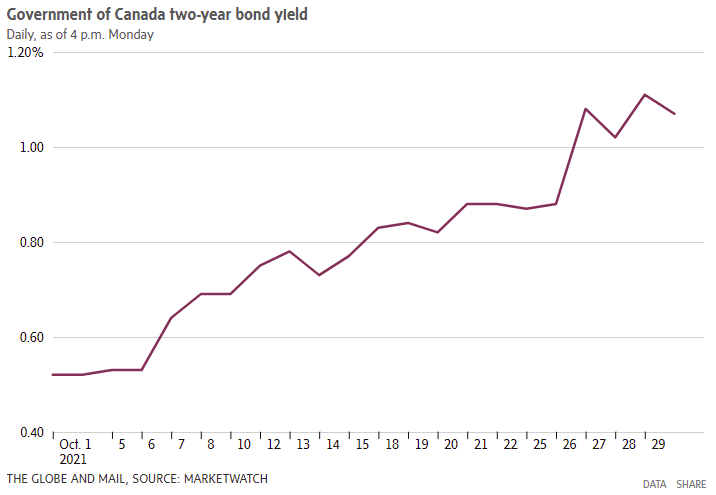
  • Pay attention to the bond market’s tantrum The bond market is having a hissy fit. Investors – even those who don’t own any bonds – should pay attention. The abrupt rise in recent days in short-term bond yields signals the belief in some quarters that central banks are suddenly waking up to inflationary dangers and trying to walk back a policy mistake. If so, interest rates could be headed up faster than thought, with dismal consequences for stock prices and real estate speculators. (Globe and Mail)

  • The bond market is acting like it knows something about inflation that Biden doesn't. Traders are betting prices will keep going up and up. The Biden administration and the Federal Reserve still expect inflation to cool down. Wall Street is starting to think they're wrong. Data out Friday confirmed Americans' concerns: decade-high inflation still isn't going away. The Personal Consumption Expenditures price index rose 0.3% in September and 4.4% year-over-year, hitting levels not seen since the Great Recession. (Business Insider)

  • The World’s Top Business Cities Are Still Failing Women No city is doing enough to keep women safe while ending gender inequality. (Citylab)

  • The United States Has Been Going Broke For Decades In 1972 the 10 year treasury yielded around 6%. From there yields only went higher. In fact, from 1972-1985, the 10 year government bond yield would average 9.6%, getting as high as 15% in the early-1980s. Today we worry about rates going from 1.3% to 1.6%. (A Wealth of Common Sense)

  • October: Another month of broken records in Victoria After a brief slowdown in the market during the summer, we’ve been on an upward trajectory again since August and in October the market again broke records in several categories. The lowest inventory on record combined with continued strong sales gave us the lowest months of inventory for any October, which drove prices accross the board to record highs. October was within a hair of the hottest market on record, beaten only slightly by March of this year. (House Hunt Victoria)

  • The coming of Age Climate Trauma Three years after a devastating wildfire, a California community faces another crisis: PTSD. Is what’s happing there a warning to the rest of us? (Washington Post)

  • Greedy Bots Cornered the Sneaker Market. What Now? But bots don’t just buy cool sneakers. They buy up those concert tickets you wanted, so they can then scalp them to you at an outrageous markup. At the beginning of the COVID pandemic, bots were buying hand sanitizer and face masks. Later, they were booking all the vaccine reservation spots. Anything that’s very high demand with a very limited supply. That’s an opportunity for the bots to become greedy hoarders and corner the market.(Slate)

  • The Stunning Grandeur of Soviet-Era Metros Between 2014 and 2020, Frank Herfort visited more than 770 metro stations in 19 cities, creating a remarkable archive of architectural and artistic splendor. (New York Times)

  • What It’s Like to Have a Record Deal and Justin Bieber For a Fan at Age 14: Prentiss Furr taught himself to make music in Jackson, Mississippi by editing YouTube videos. Now he’s playing shows in L.A. and Skrillex wants to work with him. (GQ)

Rogers Family Drama, Bond Market and Ryan Reynolds

Monday morning news drop

  • On the verge of achieving his father’s dream, Edward Rogers’s actions may be threatening to shatter it. What’s going on with the late founder’s son? Edward S. Rogers III, son of Edward S. “Ted” Rogers Jr. and grandson of Edward S. Rogers Sr., is now a force in the upper echelons of Rogers Communications Inc. But he is not CEO. Ted never passed the crown through the bloodline, despite Edward’s ambition to take Rogers’ top job. Instead, he inherited the role of chairman to the Rogers Control Trust, the family trust that controls 97.5 per cent of the telecom’s voting shares, upon his father’s death in 2008. (Toronto Star)

  • Bond market dares U.S. Fed to defy it after bloody week for investors Bond traders are looking to the Federal Reserve to support the hawkish shift that just drove parts of the global bond market to one of its wildest weeks in decades. (Bloomberg)

  • Wall Street Starts to Doubt Facebook, Its Long-time Darling The company has lagged rivals on a key measure of investor confidence. (Businessweek)

  • The Disrespect. You’re surrounded by other investors. They see things differently than you. They are operating differently than you might be. That’s okay. It’s supposed to be that way. A total and complete stranger doesn’t have to share your investment beliefs. Doesn’t have to agree with your opinions about the right way to trade or the right investments to hold. (Reformed Broker)

  • ‘The Problem Is Him’: Kara Swisher on Mark Zuckerberg’s crisis and ours. One of the main problems is what he needs to be is a nearly impossible job for anyone and he is particularly ill-suited given his lack of communication skills. He’s undereducated for the job he has because he’s not just a technologist; he’s a social engineer. And a very powerful one with no accountability. He’s like an emperor that he so admires; he was a fanboy of Augustus Caesar. That was his hero. But Augustus Caesar wasn’t really equipped to be emperor either (New York Magazine)

  • Brand in the Influencer Era: Social media is democratizing consumer influence, empowering ordinary individuals to shape brand perception. We identify brands with strong positioning using social media discourse and network structure. We find strong brands have outperformed the stock market. We also explore the trends of sustainable and Millennial brands. (Sparkline Capital)

  • Jan. 6 Protest Organizers Say They Participated in ‘Dozens’ of Planning Meetings With Members of Congress and White House Staff Some of the planners of the pro-Trump rallies that took place in Washington, D.C., have begun communicating with congressional investigators and sharing new information about what happened when the former president’s supporters stormed the U.S. Capitol. Rolling Stone spoke extensively in recent weeks to three of these witnesses, and they detailed explosive allegations that multiple members of Congress were intimately involved in planning both Trump’s efforts to overturn his election loss and the Jan. 6 events that turned violent. (Rolling Stone)

  • The MASS model of community-focused architecture A project in Rwanda convinced a group of Harvard-trained architects to rethink their building methods, material and labor sources, and the end-use of their buildings. (60 Minutes)

  • Yuval Noah Harari on the power of data, artificial intelligence and the future of the human race The bestselling author and historian offers his predictions on how technology will alter the evolution of humans and change society. (60 Minutes)

  • The “phone disaster” The Muslim population in Xinjiang, China were early smartphone adopters. Then the tech betrayed them. (Rest Of World)

  • Will Ferrell Just Wants to Entertain You (and Himself) The ‘Shrink Next Door’ producer-star on building (and winnowing) his empire, splitting with collaborator and pal Adam McKay and chasing the funny above all else: “I’ve always loved making other people laugh. I’ve just never needed to make you like me.” (Hollywood Reporter)

  • A$AP Rocky’s ‘Live.Love.A$AP’ Showed a Purple-Tinted Vision of Rap’s Future The 2011 mixtape, which finally hit streaming Friday in honor of its 10th anniversary, is at once a product of its era and rap’s present day, when regional distinctions matter less than ever (Ringer)

  • How Ryan Reynolds Built a Business Empire With a range of film and TV projects on the way, as well as initiatives through his company Maximum Effort, the actor and entrepreneur has turned his on-camera charisma into major marketing savvy. (Wall Street Journal Magazine)

Videos of the Week and the Chicago Blackhawks Scandal

Friday morning news drop and videos of the week

  • Chicago sexual assault scandal raises culture questions for NHL Kyle Beach has come forward as an accuser of former assistant coach Brad Aldrich (CBC)

  • The Blackhawks’ Past and Present Actions Show That Hockey Always Matters Most The team brass’s handling of Kyle Beach’s report in 2010 showed that they valued winning above all else. And even today, after 11 years and a lengthy investigation, that attitude seems to persist. (The Ringer)

  • The 37-Year-Olds Are Afraid of the 23-Year-Olds Who Work for Them Twenty-somethings rolling their eyes at the habits of their elders is a longstanding trend, but many employers said there’s a new boldness in the way Gen Z dictates taste. (New York Times)

  • Why Hertz’s big Tesla deal is such a blockbuster The car rental giant is making a huge bet on electric vehicles — and bringing Uber along for the ride. (Recode)

  • The Facebook Papers: Documents reveal internal fury and dissent over site’s policies (NBC News)

  • The Real Reason Facebook Changed Its Name Mark Zuckerberg wants to be the hero of the metaverse because he knows Facebook is boring. (Atlantic)

  • Forget dating apps: Here’s how the net’s newest matchmakers help you find love Fed up with apps, people looking for romance are finding inspiration on Twitter, TikTok—and even email newsletters. (MIT Technology Review)

  • Silicon Valley’s Hottest Money Apps Depend on Old-School Banks Fintechs use conventional lenders for the mechanics of moving cash (BusinessWeek)

  • Let the Market Worry For You “When I am asked what I worry about in the market, the answer usually is “nothing”, because everyone else in the market seems to spend an inordinate amount of time worrying, and so all of the relevant worries seem to be covered. My worries won’t have any impact except to detract from something much more useful, which is trying to make good long-term investment decisions.” (Irrelevant Investor)

  • Most of Canada’s marine protected areas still threatened by oil and gas, dumping and trawling: report A new assessment from the Canadian Parks and Wilderness Society finds only a fraction of established ocean conservation regions actually enjoy enough protections to meet goals of preserving or restoring marine life (Narwhal)

Videos of the Week

Weekend Slayer - Episode 9 - Victoria We've got an extra-long weekend, and the Victoria boys are showing us everything they got! Luke Fulton and Cole Nichol invite us to their Dirtjump dream yards. Craig Lunn and Alex Volokhov show us the best trails & stunts in town, and we take a trip up-island for a day of shuttling Mount Prevost with Reece Wallace, followed by a session on his trail "Mayday" with Darren Berrecloth. Grab your rigs, and join us for a rad long-weekend.

Phil Auckland | Trails are Back

Colours Of Mexico - Kilian Bron: Discover Mexico and its magnificent mix of backdrops with Kilian Bron and his team. This is a melting pot of unusual images captured in the craziest and unique places across the country! Let yourself be transported from the tops of Mexico's most active volcanoes to the steep and colourful streets of historic villages. Prepare to feast your eyes on a month’s worth of road trip turned into five minutes of images! And let's not forget, a particular mention to the complete conception of the music, in direct link with the culture of the country and the places we visited. A whole project that we can’t wait for you to see, listen to, and read, through our various forms of media. A logical sequel to "Our Tour de France" and "Follow The Light" that we’d also love you to (re)see whilst waiting for the other projects scheduled to arrive in the not too distant future. YES, we are preparing other surprises for you!

No Straight Lines // Asher Pacey RVCA Surf advocate Asher Pacey performs his version of a masterclass with his drawing of, you guessed it, No Straight Lines, in his latest edit filmed around his home country of Australia.

Out Of The Public Eye: Vans and Public Snowboards are proud to present ‘Out of the Public Eye’, a short film starring Darrell Mathes and Kas Lemmens. Founded on the idea of building community and enabling free expression, PUBLIC shares a likeminded ethos with Vans to embrace individuality and creative expression on and off the board.

BATB 12: Nyjah Huston Vs. Paul Rodriguez - Round 1 - A couple of icons here Nyjah Huston and Paul Rodriguez's histories with Battle At The Berrics are flat-out extensive, but only P-Rod has nabbed a trophy (for 2010's BATB 3). Could P-Rod make it to Finals Night again this year, or will 'Jah say nah?

Franky Villani's "Alone with My Demons" Dickies Part Franky’s a rare breed, visualizing new potential in spots, but with veteran mastery. Witness his West-Coast tear.

Ace Pelka's "Free Spirit" Madness Part Slappies have been trending upwards, but Ace elevates ‘em to another level, skipping gaps and dive-bombing buildings. He ain’t bad in a pool either.

Jonny Gasparotto's "SPLIFADELIC" Part Adding his name to the list of certified bowl burners from Brazil, Johnny literally torches the pit and commits on every rip

The Skatepark On Treasure Island: The story of an illegally constructed skatepark on San Francisco's Treasure Island, seen through the eyes of a veteran builder who has dedicated his life to the craft.

The Great Resignation, Interest Rate Hikes, and Athletic Mortality

  • ‘I quit’ is all the rage. Blip or sea change? We’ve met a once-in-a-generation “take this job and shove it” moment; For a lot of workers is their financial situation is much better than it was coming out of the Great Recession, with the expansion of the social safety net and the stimulus payments during the pandemic period. (Harvard Gazette)

  • Bank of Canada ends quantitative easing, signals rate hikes could come sooner The Bank of Canada says it expects inflation to be higher than it originally thought and suggested an interest rate hike could come sooner than expected. For now, Canada’s central bank kept its overnight rate at 0.25 per cent. It also ended its stimulus program called quantitative easing (QE). QE moves into a reinvestment phase, during which Government of Canada bonds will be bought only to replace maturing bonds. (Bank of Canada)

  • The Senior Investment Role That’s Dominated by Women Female investors are increasingly ascending to the senior ranks of their firms as newly appointed heads of sustainability. (Institutional Investor)

  • Time Horizon is Everything For Investors Two investors can have completely different opinions about a specific stock or the market and both can be right (or both can be wrong). It all depends on the time horizon. (A Wealth of Common Sense)

  • Why There Is Not Enough Housing For Sale or Rent Across the Country: Homebuilding collapsed during the housing crash over a decade ago and has been slow to recover. Construction of high-end homes and apartments recovered first, and there is now an oversupply in some urban areas across the country. However, the construction of reasonably priced homes to rent or own has only recently begun to increase and continues to lag demand. (Moody’s)

  • A History of Wealth Creation in the U.S. Equity Markets U.S. stock market investments increased shareholder wealth on net by $47.4 trillion between 1926 and 2019. Technology firms accounted for the largest share—$9.0 trillion—of the total, but telecommunications, energy and healthcare/pharmaceutical stocks created wealth disproportionate to the numbers of firms in the industries (Alpha Architect)

  • After 25 Years, Celebrating the Little Car That Saved Porsche Stuttgart gives fans a special edition Boxster that commemorates the anniversary of the time Porsche almost died. (Bloomberg)

  • Inside the battle for control of Rogers and the ensuing family feud How an inadvertent phone call exposed the plan that has plunged the telecom giant into chaos (Globe and Mail)

  • Highest-Paid NHL Players 2021-22: Connor McDavid Leads A Top Ten Still Being Stung By The Pandemic (Forbes)

  • How Long Can We Play? And what does that question even mean to you? Inside the quest to prolong athletic mortality. (Sports Ilustrated)

  • How Punk Bands ‘Selling Out’ Changed the Mainstream Music Landscape Dan Ozzi talks about his latest book ‘SELLOUT’, which documents the major label “feeding fenzy” that swept through punk in the 90s and 00s. (Vice)

Homebuyer Down Payments, the Retirement Gamble, and Harper Watters

Wednesday morning news drop

  • Parents gifting Vancouver homebuyers $340,000 on average for down payment Homebuyers in Vancouver are increasingly dependent on their parents for the financial capacity to cover their down payment. According to a new report by CIBC Capital Markets, over the first nine months of 2021, first-time homebuyers in Vancouver received an average of $180,000. This figure increases even more for parents supporting their children buying larger homes, with the average for move-uppers at $340,000. (Daily Hive)

  • B.C. government proposes legislation to speed up permitting applications B.C. has introduced the first of what is a planned series of changes to make it easier to get approvals for new housing, part of a raft of measures aimed at tackling the province’s ongoing problems with upward-spiralling rents and prices for homes. (Globe and Mail)

  • Rogers drama shows how owning a company is not the same thing as controlling it The Family trust owns almost all shares that come with voting rights (CBC)

  • Why Is Everyone Else Quitting? Sometimes, as in a collective bargaining situation, you do have to think about other people at work. Other times, it’s better to focus on what you really want. (New York Times)

  • You Could Be Competing With Bots to Buy Gifts This Christmas: As shortages of sneakers and other goods persist, the digital cat-and-mouse game between retailers and resellers is intensifying. (Businessweek)

  • Ownership Inequality in the Stock Market This data is kind of depressing. The top 10% owns 45% of the housing market while the bottom 90% owns 55% of real estate in this country. Just wait until you see the ownership numbers for financial assets: The top 1% now owns $22 trillion or about ~54% of the total in stocks and funds. The top 10% owns 89% of the stocks in this country, meaning the bottom 90% owns just 11% of the stocks. (A Wealth of Common Sense)

  • The Billionaire Tax: The Worst Tax Idea Ever? In conjunction with widening inequality, the perception is building that the wealthy don’t pay their fair share in taxes. If you focus just on federal tax dollars paid by each group, the wealthy are actually paying a larger share of federal taxes collected than ever before in history. The counter argument: they are paying a lower percent of their taxes than they were 50 years ago. (Musings on Markets)

  • 11 Un-Magical Secrets I Learned While Working at Disney World From parents leaving their kids with “Mary Poppins” to ladies lusting after Captain Jack Sparrow, the most magical place on Earth is also one of the most colorful places to work.(Bloomberg)

  • The vinyl straw: Why the vinyl industry is at breaking point The industry is at its strongest since the advent of the CD disk, so why has it become near-impossible to get music pressed onto wax? (Mix Mag)

  • In Major Shift, NIH Admits Funding Risky Virus Research in Wuhan America’s premier science institute has been less than forthcoming about risky research it has funded and failed to properly monitor. (Vanity Fair)

  • The Mysterious Case of the COVID-19 Lab-Leak Theory Did the virus spring from nature or from human error? (New Yorker)

  • Can Harper Watters Make Ballet Matter Again? The Houston social-media influencer is a gay Black man with a gift for the absurd and a passion for platform heels. He’s also a star dancer in one of the world’s most rigid, gendered, and segregated art forms. (Texas Monthly)