House Hunt Victoria, ESG in the Boardroom, and TikTok Reads Your Mind

Tuesday morning news drop

  • Why boardrooms must be fluent in the ABCs of ESG After Larry Fink demanded companies in BlackRock’s portfolio to provide climate-focused disclosures, other major investors and regulators are making similar demands (Globe and Mail)

  • Return-to-Office Chaos Is the Best Thing to Happen to Consultants Since Y2K A new breed of “experts” is here to help desperate employers navigate these uncharted waters. Too bad no one knows anything. (BusinessWeek)

  • There Is Finally a Visible Way Out of the COVID Pandemic Two new developments could mean a real endgame is near. (New York Magazine)

  • Why you should care about Facebook’s big push into the metaverse The futuristic tech Mark Zuckerberg is investing billions in could remake the internet. (Vox)

  • How TikTok Reads Your Mind It’s the most successful video app in the world. Our columnist has obtained an internal company document that offers a new level of detail about how the algorithm works. (New York Times)

  • The Best Music of 2021 So, 2021 wasn’t quite the “post-pandemic” return to normal we’d all hoped for. But once again, music carried us through, and not even ever-mutating variants could stop incredible artists from releasing great new records. Below, in our 2021 wrap-up package, Pitchfork looks back on the year that was, with lists of the best songs and albums in a variety of genres, plus the best books, best music movies and TV shows, and more. Happy new year, and, as always, thanks for reading. (Pitchfork) and top 100 Pitchfork songs of 2021 (Youtube)

  • Nature Shows How This All Works Two little stories from nature that teach us a few things about investing: 1. Extremes lead to extremes. 2. Small changes compounded for long periods of time are indistinguishable from magic. (Collaborative Fund)

  • Bubble watch: has anything changed? hough he has moved on to the pensions field, the old boss of CMHC was making news again this week on the topic of housing. In an interview with CTV, Evan Siddall said “I really don’t think we’re in a bubble. If demand is going up and supply is not, prices will go up, that’s not a bubble.” Is he right? Well he doesn’t have the greatest track record as a prognosticator of housing, but it’s a worthy topic of discussion especially if you’re wondering about whether it still makes sense to jump in to the market now or if it’s primed for a big dip. In some ways, a bubble can’t be positively identified until it has popped. I’d say we’d need to see at least a 20% drop in prices to say that what came before was a bubble. We’ve heard the Canadian housing market be called a bubble hundreds of times for decades, and despite going in radically different directions from the US market especially after 2008, so far there’s been no crash. Even if today’s prices are a bubble, those calls were clearly incorrect. A 20% drop in national prices would only bring us back to July 2020. (House Hunt Victoria)

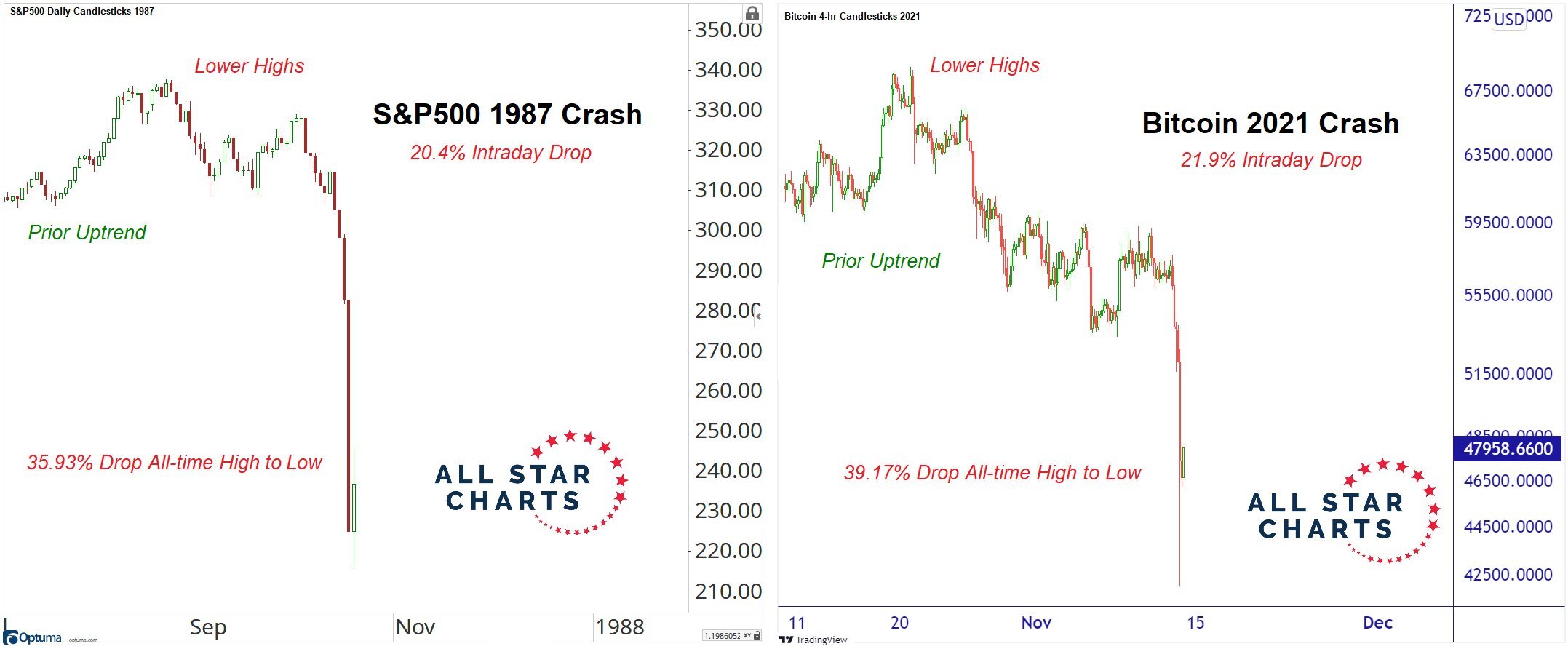
Bitcoin Sell-off, Crypto Scams, Flexible Employers, and the Market Drawdown

Monday morning news drop

  • Why employers may need to bend toward a more flexible future to stay competitive Demand for flexibility should be factored into staffing recruitment, retention efforts, experts say (CBC)

  • In the Tarantino Market, the Hottest Stocks Are Getting Quietly Killed Turmoil under the surface of the S&P 500 is reminiscent of the quant crisis. (Bloomberg)

  • 95% of the time the market is in a state of drawdown. One out of every 5 stocks is down 20% or worse from its 52 week high. One out of every 8 stocks is down 30% or more from 52 week highs and more than 6% of stocks are down 50% from one year highs. (A Wealth of Common Sense)

  • Gambling Addiction Is Metastasizing: When life feels this precarious, it’s only natural to roll the dice on just about everything. (The Atlantic)

  • Vigilantes Are Hunting Crypto Scams in $100 Billion DeFi Market These types of scams are exploding in DeFi, the wild west of the crypto market. There, anyone and everyone can mint digital tokens — some that create outrageous fortunes, and far more that flop within hours. FOMO coin culture is the perfect breeding ground for fraudsters looking to take investors’ money and run. (Bloomberg)

  • The Science of Mind Reading The results of the study were published in The New England Journal of Medicine. The paper caused a sensation. The Los Angeles Times wrote a story about it, with the headline “brains of vegetative patients show life.” It weas estimated that 20% of patients who were presumed to be vegetative were actually awake. (New Yorker)

  • The futuristic plan to fix America’s power grid This year, millions of Americans across the country lost power at times when they needed it most. As the US power grid deals with an onslaught of heat waves, winter storms, and stronger hurricanes caused by climate change, these kinds of failures are happening more often, taking longer to fix, and harming more people. Power blackouts, which used to be mostly seasonal occurrences, now occur year-round. Winter is often the season for blackouts. Smart grids could change that. (Vox)

  • Trump called aides hours before Capitol riot to discuss how to stop Biden victory Trump on the afternoon of 6 January. Multiple sources described Trump’s involvement in the effort to subvert the election result. Donald Trump on the afternoon of 6 January. Multiple sources described Trump’s involvement in the effort to subvert the election result. Sources tell Guardian Trump pressed lieutenants at Willard hotel in Washington about ways to delay certification of election result. (The Guardian)

  • Your Herbs and Spices Might Contain Arsenic, Cadmium, and Lead CR tested 126 products from McCormick, Trader Joe’s, Whole Foods, and other popular brands. Almost a third had heavy metal levels high enough to raise health concerns. (Consumer Reports)

  • A stunning shift in the way rain falls in America Think your area has had more rain than usual? You’re probably right. Think your area has had less rain than usual? Again, you’re probably right. 126 years of monthly data from the National Oceanic and Atmospheric Administration showing annual precipitation at 344 climate divisions + daily precipitation data from weather stations to measure the change in frequency of extreme rain events across the U.S. from 1951-2020. (USA Today)

Videos of the Week, Roe v Wade, Kenny Omega, and LeBron's Decline

Friday morning news drop

  • What will US’s future look like if abortion becomes a crime again? As Roe v Wade faces a direct challenge, criminal defense attorneys, prosecutors, local judges and cops begin to lay out what it would look like to criminalize abortion (Guardian)

  • New People Are Coming to Crypto — And They May Not Like Bitcoin. Specifically often associated with right-wing, anti-Fed, gold-bug types, and the fact that Bitcoin uses a lot of electricity to secure the network has helped cement the perception of “crypto” as a kind of antithesis of popular, liberal, ESG-ish ideals. But things are changing on that front, and mainstream commenters who previously turned up their noses at the space are capitulating. (Bloomberg)

  • The 'Carolina Squat' is now illegal on North Carolina's roads They're certainly eye-catching, but they're also dangerous: that's the verdict on the "Carolina squat," a modification to vehicles that raises their front while keeping their rear end low to the ground. (NPR)

  • How Morale at Facebook Tumbled After Trump’s “Looting and Shooting” Post After optimism in the company peaked at 82% in mid-May 2020, it plummeted in early June to about 60% and further sank throughout July. It dropped sharply after November, hitting 50% in December—just before the Jan. 6 Capitol insurrection, which, as the Washington Post reported as part of its own examination of the Facebook Papers, the platform played no small part in fomenting. (Slate)

  • If wrestling is art, then Kenny Omega is one of Canada's greatest performing artists The boundary-defying Winnipeg-born wrestler compares it to episodic television or a night out at the theatre (CBC)

  • LeBron's decline phase has finally arrived For years we've been wondering when all the games and minutes would finally catch up to LeBron James. And for years, right up until this season, whenever Father Time seemed to gain enough ground to appear in his rearview mirror, LeBron - the historic anomaly who continued to lord over the NBA deep into his second decade in the league - managed to pick up the pace and put some distance between himself and the unrelenting force stalking him (and the rest of us).(Score)

Videos of the Week

Joe Sexton in South Paw for Public Snowboards

Sebastian Keep - More Walls: "I want to put my wheels places no one has ever been". - Sebastian Keep.

Thomas Estaque - COMMENCAL Segment: If Thomas Estaque dreamed of a track, what would it look like? Since filming, Thomas and the shape team have redeveloped the trail to make it accessible to the entire community. For those who wish to ride it, it starts at the following GPS coordinates: 42.915732, 1.114997. Rider: Thomas Estaque. Video: Leon Perrin.

Corey Glick's "Uprise" Part

Yuto Horigome's "Spitfire" Part Yuto's had a helluva year, from droppin' his hit April part to snatchin' that weight back home. Still going, he hits LA landmarks and stacks a spine-crackin' hammer you won't forget. Jesus.

Roots - Foundations of Freeskiing - Full Film: Starring: Alex Hall, Alexis Ghisleni, Antti Ollila, Astrid Cheylus, Bella Bacon, Ben Buratti, Blake Wilson, Cody Cirillo, Daniel Hanka, Duncan Adams, Elisabeth Gerritzen, Kadi Gomis, Mac Forehand, Margaux Hackett, Markus Fohr, Matěj Švancer, Mathilde Gremaud, Micah Evangelista, Sam Anthamatten, Sandra Eie, Sarah Hoefflin, Simon Charrière, Sophia Rouches, Tim McChesney, Tim Sivignon, and Yann Rausis.

People Leaving Toronto for BC, Inflation Debate, and the Baby Bust

Thursday morning news drop

  • People Moving Out of Toronto Keep Driving Up Real Estate Prices in Other Provinces With Canadian metropolitan hubs like Toronto continuing to bring new meaning to the word "unaffordable," more and moore people are picking up and moving elsewhere in the country, whether out of choice or sheer necessity. Torontonians have become Vancouverites moving thousands of kilometres away to escape the pressure of having to earn over $200k per year. (BlogTo)

  • The inflation debate could preview the next big shifts in Canadian politics Freeland and Poilievre could be key players when their current bosses step down — or are forced out (CBC)

  • Carbon emissions to pool noodles: oilsands producers seek a ‘beautiful’ rebrand A leak of the newest industry PR offensive reveals an effort to steer attention away from pollution and toward the potential of carbon capture (Narwhal)

  • Fattest Profits Since 1950 Debunk Wage-Inflation Story of CEOs. In the second year of a pandemic that began by wiping out 20 million jobs, American workers are doing surprisingly well. It’s just that American business is doing even better. In the past two quarters, U.S. corporations outside of the finance industry posted their fattest margins since 1950 — one reason why stock markets keep hitting all-time highs. (Bloomberg)

  • The Other Side of a Mania On the other side of every mania lies the reality of the weighing machine. It was always there, lurking in the background, but in the midst of a parabolic, sentiment-driven advance, nothing could seem more irrelevant. Over the past year we’ve seen this story play out in one mania after another. And as long as human beings and their emotions are involved in markets, we’ll see plenty more in the years to come. (Compound Advisors)

  • Old Trucks for New Money The hunger for beautiful old trucks is a national phenomenon. Prices for vintage trucks rose more than fifty per cent in the past four years, twenty per cent more than the vintage-vehicle market as a whole, according to data from the collectible-car-insurance company Hagerty. The trend was evident well before the current microchip shortage sent used car prices through the roof. (New Yorker)

  • Twitter Has a New CEO; What About a New Business Model? What makes Twitter such a baffling company to analyze is that the company’s cultural impact so dramatically outweighs its financial results; last quarter Twitter’s $1.3 billion in revenue amounted to 4.4% of Facebook’s $29.0 billion, and yet you can make the case — and I believe it — that Twitter’s overall impact on the world is just as big, if not larger than its drastically larger peer. (Stratechery)

  • Republicans are quietly rigging election maps to ensure permanent rule The past decade in Ohio shows how bad it can get – and how quickly. Despite the state’s voters often swinging Democratic, 75% of its congressional delegates are Republican (The Guardian)

  • Baby bust: More Victorians aren’t having kids. Here’s why we should care. Citing the housing crisis, climate anxiety, precarious work, and more, many in Victoria are choosing to delay parenthood or skip it altogether (Capital Daily)

  • Britney Spears, the Newly Liberated Princess of Pop: In November, five months after a June hearing at which Spears said she felt like a prisoner in the court-ordered conservatorship her father oversaw for almost 14 years, a judge dissolved it. (Businessweek)

House Hunt Victoria, Magic Mushrooms, and Tiger Woods Retirement

Wednesday morning news drop

  • Take Two Shrooms and Call Me in the Morning: The Medical Promise of Magic Mushrooms Psilocybin can treat depression, alcoholism, PTSD, and even cluster headaches. Why is it still illegal? (Walrus)

  • Move Over, GE. The Tech Conglomerates Are the New Leaders of Industry. As General Electric and other old-school behemoths break up, Amazon, Apple, Alphabet, Microsoft and Meta are taking their place as the do-everything companies of the future (Wall Street Journal)

  • Inflation Bonds Are Betting on Team Transitory Inflation-protected securities have a story to tell about rising prices, and it isn’t the panicky one that’s circulating in political circles and news reports. (Bloomberg)

  • When Did Stocks Peak? The S&P 500 is not the stock market. Well, technically it is. But since the index is weighted by company size, looking at it in isolation can provide an incomplete picture as to what’s happening at the individual company level. (Irrelevant Investor)

  • Could Roads Recharge Electric Cars? The Technology May Be Close. But challenges await, including technical issues, regulatory barriers and many miles of highway. (New York Times)

  • Where Magic Happens How a kids hospital is redefining possibilities for all children and youth (Walrus)

  • The Battle Between YouTube And Twitch Heats Up, As Ludwig Moves To YouTube Gaming A streak of Twitch streamers switching platforms continues, as Ludwig Ahgren with his 3.1 million followers announced he will be streaming exclusively on YouTube Gaming for a $30 million dollar contract. (Forbes)

  • College football gone mad. In the span of two days, the head coaches of two of the biggest college football programs in America have jumped ship, wooed by even greater challenges — and $100 million contracts. (Axios)

  • Tiger Woods has delivered his own career’s eulogy. If only the golf world would listen On Tuesday, more than 10 months after shattering his right leg in a car accident, Tiger Woods tried to retire. In his first public presser since the crash, he explained to reporters how bad it had been. How he had no memory of the crash. How he spent three months stuck in a hospital bed afterward. How amputation had been “on the table” as an option. “I’m lucky to be alive,” Woods said. (Globe and Mail)

  • November: Sales slowing with season, but no relief in market conditions Second to the spring market, the fall generally brings a resurgence in both new listings and sales to the Victoria market. This starts after labour day, and normally dies down by the end of October. The sellers that don’t manage a sale by the end of October generally de-list their properties and try again the following spring as buyers become ever more scarce closer to the holidays. (House Hunt Victoria)

Holiday Shopping, Multi Level Marketing, The Great Resignation, and Steph Curry

Tuesday morning news drop

  • The Holiday Shopping Season Is Here, but Is It Back? Shoppers are returning to stores in much bigger numbers than last year, but the atmosphere is not quite as carefree as the prepandemic days of 2019. (New York Times)

  • When MultiLevel Marketing Met Gen Z Amelia Whelan used social media as an accelerant for her sales community. Then things blew up. (Atlantic)

  • What is 'The Great Resignation'? An expert explains The Great Resignation is a phenomenon that describes record numbers of people leaving their jobs after the COVID-19 pandemic ends. Companies now have to navigate the ripple effects of the pandemic and re-evaluate how to retain talent. Dr. Isabell Welpe explains what we can learn from this recent trend in the workforce. (World Economic Forum)

  • Workers Quit Jobs in Droves to Become Their Own Bosses Seeking flexibility or escape from corporate bureaucracy, employees discover their inner entrepreneur (Wall Street Journal)

  • Wall Street Grudgingly Allows Remote Work as Bankers Dig In Finance employees who couldn’t imagine working from home before the pandemic are now reluctant to return to the office. Their bosses can’t figure out how to bring them back. (New York Times)

  • Condo owners face growing insurance bills for damage to common areas Many condo buildings are raising their deductibles, which helps lower the annual cost of insurance, but the cost of a higher deductible is then passed to condo owners when a building submits a claim for damages. (Globe and Mail)

  • Getting Inflation Right Is a Make-or-Break Moment on Wall Street For a generation of investing pros, stable prices were a fact of life. What do you do when the old assumptions stop making sense? (Businessweek)

  • The Shocking Truth About Today’s P/E Ratios: P/Es don’t fit the narrative of a wildly overpriced stock market. (Fisher Investments)

  • Is Crypto Bullshit? I regret to inform you that it’s totally legit and crypto/blockchain networks really might be technologically, economically, and politically transformative. Ugh. (Model Citizen)

  • CEO: I am all in on Defi We started as a financial media company, transitioned to ETFs when I saw how transformative they were for the investing process. I believe DeFi is going to meaningfully transform the economics of financial services. (WisdomTree)

  • The Teenagers Getting Six Figures to Leave Their High Schools for Basketball The new pro league Overtime Elite is luring young phenoms with hefty salaries, viral success and — perhaps — a better path to the N.B.A. (New York Times)

  • Stephen Curry is better than ever, and the Warriors’ traveling circus is back Stephen Curry and the Golden State Warriors are the NBA's biggest attraction through the first quarter of the season. In recent weeks, Curry, the beloved ringmaster of a traveling circus that reached five straight NBA Finals from 2015 to 2019, has drawn “MVP” chants from Brooklyn to Los Angeles. After leaving the Clippers in the dust with a signature fourth-quarter flurry Sunday, he exited the Staples Center court to a standing ovation and was greeted by hundreds of fans begging for sneakers, grasping for hugs, shouting his name and angling their cellphone cameras in his direction. Many had arrived before noon to ogle his extensive pregame routine. The Warriors, owners of the NBA’s best record and top point differential through the first quarter of the season, are once again feeling the crushing effects of their popularity. (Washington Post)

  • Reese Witherspoon Isn’t Afraid to Say She’s the Best: With her recent nine-figure money moves and a full slate of upcoming projects, the Morning Show star is like the Lebron James of Hollywood — and she’ll be the first to tell you. (InStyle)

Virgil Abloh Passes Away, Ontario's Greenbelt, and Housing Affordability

Monday morning news drop

  • Virgil Abloh: The Designer of Progress Virgil Abloh, who has died today aged 41, will be remembered as one of the most popular and influential fashion designers of his era. As both the founder of Off-White and the Creative Director of Menswear for Louis Vuitton, Abloh’s ascent from show-crashing fashion tourist in 2009 to the very apex of the global luxury industry at the time of his passing is arguably the defining fashion story of the 2010s. For as both an African American and a creative whose work emerged from the rag-tag genre of streetwear—a genre whose definition he regularly contested—Abloh was the seminal boundary breaker in a notoriously bordered business. (Vogue)

  • Virgil Abloh, Menswear’s Biggest Star How the creative director brought something new to high fashion. (New Yorker)

  • Covid misinformation spreads because so many Americans are awful at math Two-step calculations are hard enough for some, but assessing vaccine effectiveness requires multiple steps. (Washington Post)

  • Everything you need to know about the endangered species, waterways and farmland in southern Ontario’s Greenbelt More than nine million people live within 20 kilometres of Ontario’s two-million-acre protected Greenbelt. For two decades, it's been hailed as a conservation success story, but it’s still under pressure from urban sprawl. (Narwhal)

  • Why more housing supply won’t solve unaffordability Five reasons this superficial solution to combating house price escalation often doesn't work. The city of Vancouver has added more housing units per capita than any city in North America over the last 30 years, yet housing prices have increased faster in Vancouver than any other North American city. (Vancouver Sun)

  • For Recruiters and Job-Seekers, It’s a Whole New Ball Game Asset owners and managers both face challenges as they search for talent in an employment environment turned upside-down by the pandemic. (Institutional Investor)

  • So You Wanna Be a Stock Picker I’m a big proponent of index funds. This doesn’t mean I disavow active management, but I think most people should get most of their exposure to stocks through an index. Picking stocks is hard, time-consuming, and emotionally exhausting. Even if you are able to outperform, it’s probably not worth the time necessary to achieve said outperformance. Tens and hundreds of hours to maybe beat the benchmark by a few percent doesn’t seem like a great trade. Unless it’s your passion, in which case you probably already stopped reading.(Irrelevant Investor)

  • Supply chains are screwing with prices for a lot of the world; It isn’t just a US thing. It turns out, the global economy can go a little haywire when a once-in-a-generation pandemic rolls around. The virus scrambled supply chains, squeezed off international travel, and shut down businesses and services. Now, even as the world is recovering from these shocks, Covid-19 is still surging and resurging, and combined with other disruptions — like climate-related events — supply chains are still trying to sort themselves out. (Vox)

  • The Women Behind Historic House Designs“ The designers, the architects involved — in many instances those were women, or women were part of the team,” says Christina Morris, manager of the year-old “Where Women Made History” initiative for the National Trust for Historic Preservation, which owns the Edith Farnsworth House. “They were the patrons, they were the owners. Women were responsible for creating the preservation movement and continue to lead it today.” (CityLab)

  • Why Do So Many Young Americans Hate Sports? Nearly 30% of people under the age of 25 say they actively dislike sports, an alarming figure for leagues and their broadcasters. Why the decline in live sports viewership? Nielsen, the ratings analytics giant, said in 2019 that Gen Z individuals “have higher expectations for entertainment experiences than their elders, and new ways to discover and consume content.” Given the size of the sports industry complex — worth tens of billions of dollars a year in revenue, including about $20 billion in media rights — such precipitous drops of interest among young people raise concerns about the long-term sustainability of sports leagues and the media companies broadcasting their content. Market data paints a grim picture for the future of pro sports. In league offices around the country, the campaign to secure it is well underway. Stakeholders have taken notice. (Inside Hook)

  • Taylor Swift’s Quest for Justice: With “Red (Taylor’s Version),” Swift seeks to reclaim control in her business affairs and in matters of the heart. (New Yorker)

Videos of the Week, Ski Towns, Oysters and Floods, and AEW vs WWE

  • This could finally be Sears’ and Kmart’s last holiday shopping season This Black Friday could very likely be the start of the final holiday shopping season for Sears and Kmart, two brands that once proudly dominated the US retail landscape. The two chains are only a shell of what they were when the holding company that owns both emerged from bankruptcy less than three years ago. (CNN)

  • How to Save a Ski Town All over the West, a housing crisis is causing workforce shortages, crippling local businesses, and threatening the culture and existence of mountain towns as we know them. But amid the doom and gloom, some people are fighting for solutions. (Outside)

  • New York City Is Building a Wall of Oysters to Fend Off Floods Thousands of acres of undersea reefs once protected the city’s shoreline. Now an army of volunteers is bringing the bivalves back, one shell at a time. (CityLab)

  • Regulatory riddle: An investigation into the SEC v. Ripple case and its consequences for crypto The rapidly expanding crypto business is attracting regulatory scrutiny from the SEC (Fox Business)

  • Everyone’s Moving to Texas. Here’s Why. As the Golden Gate shuts, the Lone Star beckons. If you’re looking for an affordable, economically vibrant city that is less likely to be damaged by climate change than many other American cities, our data shows why Texas is a new land of plenty. (New York Times)

  • How Serena Williams Is Making Massive Social Impact Through Venture Capital With over 50 portfolio companies with a $33 billion market cap and 60 percent diverse founder investments, Serena Ventures is making waves in the venture capital world by investing in mission-driven companies. (Worth)

  • AEW is WWE’s first real fight in decades. It may change the face of pro wrestling in the U.S. While WWE continues to be the pro wrestling juggernaut in business and pop culture, AEW sees the company as vulnerable. Dave Meltzer, the longtime wrestling historian and journalist with the Wrestling Observer, said in an interview that AEW’s campaign to become the alternative to WWE has ushered in “the most interesting and exciting time in pro wrestling” since 1999. The late 1990s brought what’s known as the industry’s “Attitude Era” for megastars and increased violence and sexual content, which were shown to be highly effective in luring larger audiences. (Washington Post)

  • CM Punk VS. MJF: The Moment the Wrestling World Has Been Waiting for Didn't Disappoint - Is wrestling and the art of the promo dead? MJF - “Cause I’m about to verbally finish you quicker than your ufc career”

Videos of the Week

Shit Waves Vol. 3 - Chapter 11 TV

John Dilo's "Red Tiger" Almost Part Dilo’s power-packed skating hits new heights as he demolishes massive sets and oversees the next evolution of manuals.

Will Marshall Dime Part Will attacks double stacks and brings the heat to New York’s streets in yet another strong showing. Big ups.

Eight Days In The Desert: A long week for diggers, riders, and media team. The vibes were high and everyone threw down. This is Rampage 2021.

Vans x Cult BMX Presents: Never Fade | BMX | VANS Never Fade symbolizes the Vans X Cult relationship and love for BMX in a ten-year strong partnership. With the sixth Vans X Cult product collaboration Dakota Roche and Cult Founder Robbie Morales share their appreciation of the association. At the same time, the rest of the Cult team let their riding do the talking in a look that reflects Cult BMX and what it stands for, to Never Fade.

CULTCREW/ SEAN RICANY/ VX Sean Ricany laying down lines in socal. Dak capturing and cutting it all on his classic VX for your entertainment.

Supply Chain Issues, BC Floods and Pipelines, and Kobe's Sneakers

Thursday morning news drop

  • Ask a Supply Chain Expert: Are Product Shortages Our New Normal? ’Tis the season to unpack the pandemic’s impact on production and distribution (Walrus)

  • Canada’s big banks expected to raise dividends next week but size of increases will vary widely Bank buildings are photographed in Toronto's financial district on June 27, 2018. When The Big Six banks announce earnings for their fiscal fourth quarter next week, dividends could rise by an average of 20 per cent, according to analysts. (Globe and Mail)

  • B.C. flooding exposes pipeline, raises concerns along Trans Mountain route The federally-owned company says there have been no leaks along the existing route but crews are working to inspect for any damage (Narwhal)

  • Why NBA players are hoarding Kobe Bryant's Nike sneaker line On a quiet evening a few weeks before the start of the regular season, Wilson Taylor was deep inside Paycom Center's laundry room, which doubles as the Oklahoma City Thunder equipment manager's deep storage facility. At a rack pushed up against the wall, he ran his hands over a layer of dust on a cluster of black and gold Nike shoe boxes. Kobe 8 System TB, size 13.5. He smiled, knowing the score he'd just uncovered. He pulled out his phone, took a picture and texted it to Thunder rookie guard Josh Giddey. "No way!" Giddey wrote back. "Can I come right now?" (ESPN)

  • A look under the hood of the most successful streaming service on the planet: Netflix’s secret sauce is something none of us ever see A service’s guts, the engineering behind the app itself, are the foundation of any streamer’s success, and Netflix has spent the last 10 years building out an expansive server network called Open Connect in order to avoid many modern streaming headaches. It’s the thing that’s allowed Netflix to serve up a far more reliable experience than its competitors and not falter when some 111 million users tuned in to Squid Game. (The Verge)

  • Ten Crypto — Or Web 3.0 — Arguments to Bluff Your Way Through Thanksgiving How to survive the most contentious day of the year (Bloomberg)

  • We Live By a Unit of Time That Doesn’t Make Sense: The seven-day week has survived for millennia, despite attempts to make it less chaotic. (The Atlantic)

  • The most infamous balloon mishaps from the Macy’s Thanksgiving Day Parade Macy’s Thanksgiving Day Parade is all fun and games until one of the balloons goes down. Since the parade started marching balloons around Manhattan in 1927, the massive floating figures have occasionally come untethered, blown clear away, or been punctured, stabbed, deflated and subjected to all sorts of ignominy. (CNN)

  • Keanu Reeves Knows the Secrets of the Universe Guy’s always working—sixty-eight movies in thirty-five years. Playing killing machines, doofuses, romantics, messiahs, and devils. But always Keanu. Which always means something more. (Esquire)

  • Environmental concerns raised as ‘iceberg homes’ become more popular Some wealthy homeowners are looking to expand by building below ground to create an ‘iceberg home,’ where more of the house is below ground than above. But as the properties grow in popularity, so do the environmental concerns.

Great Reconsideration, Office Holiday Parties, and Bryson DeChambeau vs. Brooks Koepka

Wednesday morning news drop

  • Great Resignation? Tech Workers Try a Great Reconsideration Instead More Americans are quitting their jobs than ever before. Some engineers are finding new workplaces to prioritize their own wellbeing. (Wired)

  • Office holiday parties are back and smaller than ever People either love or hate office holiday parties. Pretty much everyone hates virtual office holiday parties. As we enter the second pandemic holiday season, both types of events — meant to celebrate employees and humanize bosses — are back. But they are probably different from what you remember. (Vox)

  • The Conglomerate Paradox: As GE splinters You might call this the end of the conglomerate age. But, the truth is, that age ended decades ago in the United States. GE is just one of a few lumbering dinosaurs that survived the asteroid crash. But while the old American conglomerates are going extinct, a new breed is evolving to take their place at the top of the food chain: Techglomerates. Companies like Google, Facebook, and Amazon have been acquiring companies and entering into industries they’ve traditionally had no involvement in. (NPR)

  • The Winds of Change The last 20 months have been a most unusual period, thanks primarily to the pandemic, yet many things feel like they haven’t changed over that time span. Each day seems like all the others. I mostly stay home and deal with email and Zoom calls – whether relating to work matters or not. Weekdays don’t feel that different from weekends (this was especially true pre-vaccine, when we rarely ate out or visited others). We’ve had only one one-week vacation in two years. The best way to sum it up is through a comparison to Groundhog Day: every day feels a lot like the day before. (Oaktree Capital)

  • Bank of Canada warns of elevated household debt as interest rates are set to rise In a speech about the stability of the financial system, Bank of Canada deputy governor Paul Beaudry said that Canadians who stretched their finances to buy into the white-hot real estate market are highly exposed to rising debt servicing costs. (Globe and Mail)

  • To Bet on Inflation Is to Bet Against Human Ingenuity David Rosenberg, founder of Rosenberg Research, doesn’t expect a sustained surge in inflation. In an in-depth interview, he explains how investors can position themselves for a disinflationary market environment and which indicators he’s paying particular attention to. (The Market)

  • How Music Created Silicon Valley The tech titans couldn’t have built their empires without songs—and now they are destroying the cultural ecosystem that made them rich (The Honest Broker)

  • The Pigeon Puzzle: How Do They Figure Out Their Impossibly Long Routes Home? From around 2000 BCE, when it’s thought that ancient Sumerians discovered pigeons’ amazing homing abilities, to now, we still don’t quite know how these birds orient themselves in the sky. Scientists have various theories, but they have yet to fully understand the phenomenon. “It’s a mystery. It’s part of what makes the sport so interesting.” (The Walrus)

  • Inside the Cozy Modern Home of Hockey All-Star Connor McDavid The Alberta, Canada, abode was designed by his girlfriend Lauren Kyle (Architectural Digest)

  • Edward Rogers has been a pretty good Blue Jays owner, but what could someone new do? It’s in the nature of owning a big-time pro sports team that everyone thinks you are doing a terrible job at it. If the team doesn’t win, you’re stupid. If the team isn’t interesting, you’re cheap. If things do happen to go right, that’s because you had enough baseline intelligence to understand that you are bad at sports and so hired other, brighter people to do the sports for you. But it still doesn’t make you smart. (Globe and Mail)

  • Bryson DeChambeau Says Feud with Brooks Koepka is 'All Real' Morning Read's Brian Hurlburt was in video media sessions with Brooks and Bryson, who either really don't like each other or are going out of their way to make it seem like they don't to promote the Match at Wynn Golf Club. (Sports Illustrated)

  • Bryson DeChambeau vs. Brooks Koepka feud timeline: How it started in 2019 and snowballed to 'The Match' Golf's most famous feud from the last couple years will take center stage during the fifth edition of "The Match" on Friday, Nov. 26. (Sporting News)