Construction Industry Technology, Streaming, Truck Driver Shortages, and the Crypto Crash

Thursday morning news drop

  • Construction in a digital world A deep dive into technological adoption in Canada’s construction industry. Many construction firms have had little incentive to invest in technology, with current procurement practices placing much of the project risk and associated costs on the shoulders of contractors. The benefits, however, are becoming more apparent. With a workforce shortage, climate change realities and solutions reaching greater maturity, the industry is poised for significant transformation. Companies that seize the digital opportunity and integrate with others in their ecosystem over the next decade stand to gain a significant competitive advantage. Construction companies are starting to see the competitive advantages made possible by technology, and we encourage them to keep working from this perspective. The companies that come out ahead will be those that don’t wait: Develop a vision, hire a team and get started. (Canadian Construction Association)

  • Streaming TV Costs Add Up as Americans Add More Services U.S. consumers turned to Netflix, Disney+, HBO Max and others like never before during the height of the pandemic, stuck indoors and starving for novelty (and something to distract their kids). Several services, including Peacock and Discovery+, launched in the middle of it all. People are subscribing to more services than they were a year ago—and their budgets have gone up, too. (Bloomberg)

  • Why Amazon is paying nearly $9 billion for MGM and James Bond Amazon isn’t competing with Netflix, but it is spending billions trying to figure out Hollywood. Maybe 007 can help. (Vox)

  • Is There Really A Truck Driver Shortage? The real problem is not a shortage but retention. According to ATA’s statistics, the average annual turnover rate for long-haul truckers at big trucking companies has been greater than 90% for decades. If a company has 10 truckers, nine will be gone within a year because so many new drivers leave within a few months. (NPR)

  • Meet Your Next Angel Investor. They’re 19 A growing cohort of Gen Z investors who are beginning to make their mark on the startup ecosystem. Like-minded young people congregate on TikTok and Twitter, where talk of startups can lead to valuable connections and deal flow. A Slack group called Gen Z VC has more than 7,000 members, many of them still in their teens. (Wired)

  • 4 Lessons From the Crypto Crash You have to stay in the game to survive as an investor. (A Wealth of Common Sense)

  • Is Our Political System Up for the Fight Against Climate Change? A revolutionary politics isn’t necessary to combat a world-changing problem. But, to succeed, liberal democracies must adapt (Walrus)

  • A Giant Old Growth Cedar Rolling Down a BC Highway Went Viral. What’s Its Story? As a new ‘war in the woods’ brews, a social media post has emerged as a rallying call. (Tyee)\

OldGrowthCedarHighway.jpg
greencapital.png

House Hunt Victoria, Inflation, Sneaker Colours, the Future of Shopping, and Cumberland

Wednesday morning news drop

  • And Just Like That, Amazon Will Acquire MGM for $8.45 Billion The deal, which was rumored to be in the works last week, will find MGM’s storied catalog merging with streaming giant Amazon Studios. (Vanity Fair) The deal would add Metro-Goldwyn-Mayer’s 4,000 films to Amazon’s streaming library, including the James Bond, Rocky and “Legally Blonde” franchises. (New York Times)

  • What rising inflation means to the loonie and the timing of a Bank of Canada rate hike Our central bank may soon have reason to welcome a higher dollar (Financial Post)

  • No, Millennials Aren’t Poorer Than Previous Generations The data suggests that the narrative around Millennial wealth isn’t as extreme as the media makes it out to be. The same thing is true if we examine income (Of Dollars And Data)

  • Here Are the Ways the Pandemic Changed Hollywood: A viewer’s guide to the future of entertainment, where blockbusters no longer require cinemas, studios make sitcoms again, and more. (Businessweek)

  • The Secret Psychology of Sneaker Colours: You think they randomly choose those glaring shades of Nike, Adidas and New Balance? Think again (New York Times)

  • What will shopping look like? The pandemic has permanently changed how Americans shop, from wider aisles to curbside pickup. (Vox)

  • This Evolutionary Gift May Protect Coral From Climate Change Coral in the Red Sea is unusually heat tolerant. The secret to its success may lie in the lucky confluence of geography and genetics. (Wired)

  • The Marathon Men Who Can't Go Home In the north Bronx, a small group of elite Ethiopian runners struggle to survive. The persecution they fled was far more harrowing. (GQ)

  • From coal to cool: Cumberland booms again When a sleepy town attracts wealthy digital nomads, what happens to its old-school charm? (Capital Daily)

  • Do high priced cities attract the wealthy? Despite the fact that house prices have spiked across the country during this pandemic, there are still radical differences between prices between our most expensive and cheapest markets. The chart below shows the difference between Victoria average prices and several major cities. (House Hunt Victoria)

othercities.png
networth.jpg

Economy, Housing Market, Middle Class, Debt and Horse Racing

Tuesday morning news drop after a long weekend

  • The Economy Is Booming. Why Don’t Firms Believe It? Rather than an economic crash during the pandemic, we have instead seen aging supply lines straining under a surge in demand, the likes of which hasn’t been seen for decades. Whether in lumber, shipping, semiconductors, or any of a range of industries, this has been a fascinating through-line (Bloomberg)

  • Houses Have Gotten Bigger and Nicer Part of the unaffordability problem is that expectations have gotten ahead of reality. Houses were more affordable for our parents because the ones they were buying bare little resemblance to the ones we’re buying. (Irrelevant Investor)

  • Did HGTV Ruin the Housing Market For Millennials? First-time homebuyers aren’t thrilled with the housing market at the moment. It’s not a buyer’s market despite (or because?) Interest rates remain at generationally low levels. What if young people are unhappy with the housing market because their expectations are too high? What if our tastes have become too expensive? (A Wealth of Common Sense)

  • How McKinsey Destroyed the Middle Class Technocratic management, no matter how brilliant, cannot unwind structural inequalities. Things changed in the 1960s, with McKinsey leading the way (The Atlantic)

  • Many Americans struggle with debt. Social media doesn’t help. Instagram and TikTok are full of things to buy. For some users, it’s a trap, with social media leading some users into debt (Vox)

  • Can Horse Racing Survive? In a time of changing sensitivities, an ancient sport struggles to justify itself. Thoroughbred racing, once the most popular spectator sport in America, has been in decline. In the past two decades, the over-all national betting handle at racetracks has fallen by nearly fifty per cent. Dozens of tracks have closed. Racing is still a fifteen-billion-dollar industry, but the number of races and the size of the thoroughbred-foal crop are less than half what they were in 1990. (New Yorker)

  • All hail King Pokémon! Gary Haase has amassed the world’s most expensive Pokémon card collection, valued at over $10 million. So why isn’t he cashing in? (Input)

  • How the Pandemic Has Changed Attitudes Toward Wealth Americans found that money cannot buy everything, and they used their wealth to build relationships and help others, according to two recent surveys. (New York Times)

  • Stages of Grief: What the pandemic has done to the arts The pandemic has been devastating for the arts economy. Live events were the first things to stop, and they will be the last to return. That means musicians, actors, and dancers, plus all the people who enable them to take the stage—playwrights and choreographers, directors and conductors, lighting designers and makeup artists, roadies, ushers, ticket takers, theater managers—have no way to make a living from their work, and haven’t for more than a year. (Harper’s Magazine)

  • The Fall of the House of Gates? Fully reckoning with Bill Gates means not just focusing on how he treats women—vital as that is—but also confronting our own deep-seated worship of wealth and hardwired belief in hero narratives. (The Nation)

  • Ford’s F-150 Lightning Is Winning the EV Truck War for One Simple Reason This is a case of the early bird getting the worm, but not in the way you might expect. While other automakers may beat Ford to the starting line, Ford is set to beat everyone else to market with an electric truck that’s accessible, affordable and enticing to America’s gas-loving truck owners — and there are a heck of a lot of them. (Inside Hook)

  • Inside the Rise and Fall (and Rise and Fall) of Shit Coins Welcome to the era of “pump and dump,” where investors bummed about missing out on getting rich with Bitcoin are being taken for rides by online jokesters pushing tokens with nonsensical names and no clear value. (Vanity Fair)

  • Why Amazon is paying $9 billion for MGM and James Bond Amazon isn’t competing with Netflix, but it is spending billions trying to figure out Hollywood. Maybe 007 can help. (Recode)

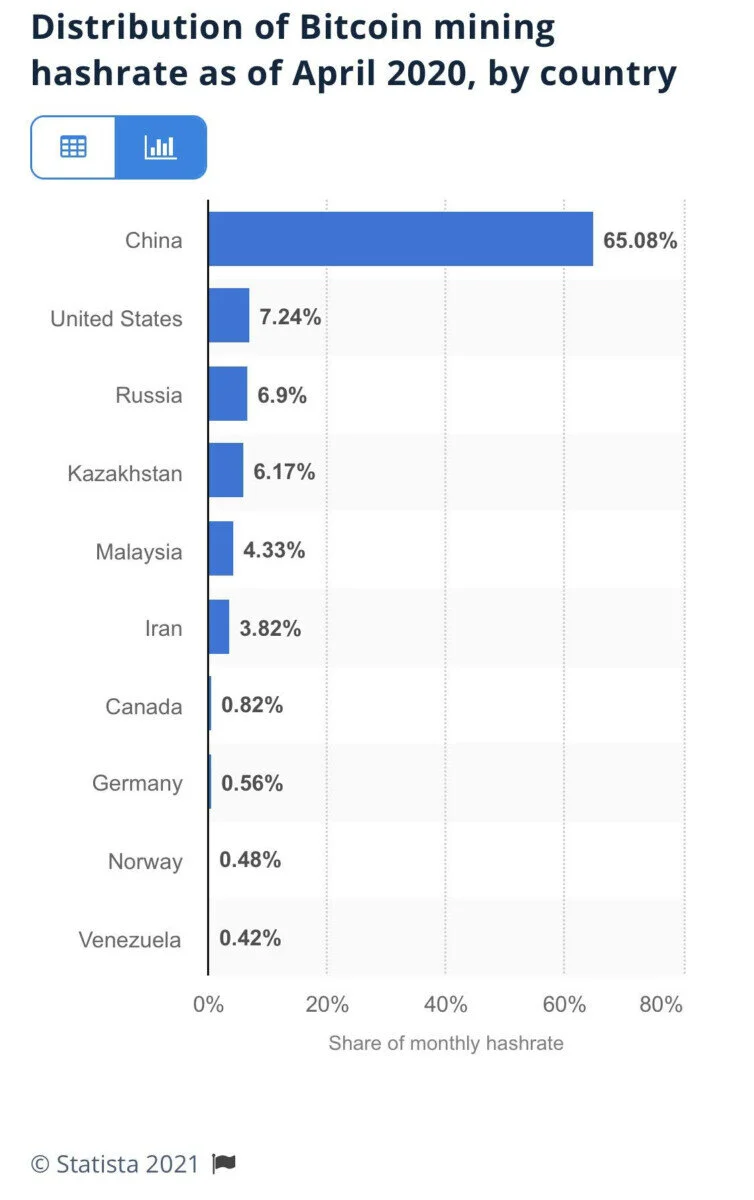
  • Ethereum Closes In on Long-Sought Fix to Cut Energy Use Over 99% Shift could boost Ether as Bitcoin’s environmental rap worsens; ETH’s 45,000 gigawatt usage may fall to 1/10,000th of that. (Bloomberg)

distribution-of-bitcoin-mining-hasrate.jpeg

Videos of the Week, Canadian Steel, Inflation, Apple Screwed Facebook, and Depression

Friday morning news drop

  • Canada's steel industry has a secret weapon that could soon beat China's cheaper bids Canadian steel has one of the lowest carbon footprints in the world, a standard that may soon carry more weight than price (Financial Post)

  • World-Dominating Superstar Firms Get Bigger, Techier, and More Chinese The world’s biggest businesses were doing fine until Covid-19 arrived. Now they’re doing even better. The top 50 companies by value added $4.5 trillion of stock market capitalization in 2020, taking their combined worth to about 28% of global gross domestic product. Three decades ago the equivalent figure was less than 5%. (Businessweek)

  • The Strongest Sign Yet That Inflation Is Transitory After a year of soaring prices, some builders — and homebuyers — are beginning to step back. The rest of the economy may follow suit. (Bloomberg)

  • How Apple screwed Facebook Apple’s iOS 14.5 update has triggered an unstoppable collapse in Facebook’s ability to collect user data (Wired)

  • The U.S. Is Not Ready For An All-Electric Future The U.S. is woefully unprepared to handle “the electrification of everything.” Increased electrification in all sectors will need huge investments in the electric grid, in battery storage to back up renewable power generation, in charging points for EVs, and in technologies such as green hydrogen to help those technologies to reach maturity and cost efficiency enough to start replacing fossil fuels. (Oilprice)

  • What Happens to Our Brains When We Get Depressed? The human brain, in all its complexity, is nearly impossible to model. One neuroscientist is trying anyway (Walrus)

Videos of the week

No Way - The Hans Rey Story - Documentary from 2004 This documentary chronicles arguably the most famous mountain biker and trials rider’s life and biking career until 2003. From Hans’ upbringings in Germany as a Trials rider, to his move to America where he helped pioneer mountain biking and some of its subcultures such as Freeride, Trials, Extreme Biking and Adventure. His story is an inspiring tale of how a boy with a bike and dream made his way into the Mountain Bike Hall of Fame. Classic and rare footage, as well as interviews from Steve Peat, Brian Lopes, John Tomac, Richie Schley, Wade Simmons, Gary Turner and Hans' parents.

Bike Trials World Champion - Portsmouth street riding 2021 Charlie Rolls - street edit! here it is

Dunbar Cycles Team Rider Gabe Neron shredding Cypress Jank! 🤘

Flow State - feat Josh Lowe Kona Downhill Mountain Bike team rider Josh Lowe getting into his flow state with big whips and big air riding at Wind Hill B1kepark on the "Viagra Falls"trail.

'WHOOPS' FT. HOBIE DOAN, BRETT SILVA, JULIAN ARTEAGA, TRENT LUTZKE & MORE | DIG BMX

LEWIS MILLS - "Controller Bar" / ÉCLAT BMX

Clive Dixon's "Prine" Part Clive demolishes an abandoned warehouse and hits rails too insane to describe at breakneck speed. The dude ain’t human.

Franky Villani's "One Big RAW Mess" Part Franky’s stunts and envelope-pushing tech all require some serious skin shedding. See how he muscles through it.

Housing Crisis in Canada, the Case Against Bitcoin, F150 Lightining, and MLB No-Hitters

Thursday morning news drop

  • The Case Against Bitcoin: Peter Thiel’s former portfolio manager says that the crypto narrative is built on half-truths and a nonchalance about the security provided by the nation-state. (Bari Weiss)

  • Stop Worrying and Love the F-150 Lightning Ford’s first electric pickup truck signals that decarbonization has entered a new era. (The Atlantic)

  • Can Apple change ads? Apple has built up its own ad system on the iPhone, which records, tracks and targets users and serves them ads, but does this on the device itself rather than on the cloud, and only its own apps and services. Apple tracks lots of different aspects of your behaviour and uses that data to put you into anonymised interest-based cohorts and serve you ads that are targeted to your interests, in the App Store, Stocks and News apps (Benedict Evans)

  • Trump Officials Skirted Rules to Reward Politically Connected and Untested Firms With Huge Pandemic Contracts House Democrats investigating the COVID-19 response say Trump adviser Peter Navarro pressured agencies to award deals worth hundreds of millions of dollars. (ProPublica)

  • Why Have There Been So Many No-Hitters in 2021? Pitchers are better than ever. Hitters seem worse than ever. With six no-hitters by May 19, baseball is two away from tying the full-season record, which was set in 1884. (New York Times)

  • How to make space How Victoria could flip the script on density. What would that city look like? What would it feel like? (Capital Daily)

  • ‘Sick City’: What the Pandemic Tells Us about Our Housing Crisis Patrick Condon’s new book ties public health to the price of land. His cures are provocative. (Tyee)

  • The second-largest country in the world is running out of land Canada’s housing market is running hotter than just about anywhere else in the world. But despite the anxiety about irrational bidding wars and fears of the bubble bursting, what's fundamentally driving it is a worsening imbalance between supply and demand: Buyers want large homes but increasingly can’t have them because there isn’t enough space in and around the major cities where people work. (Bloomberg)

Housing in Victoria, BC

This hideous house on the right can be built without any approvals and is legal everywhere in Victoria, within the zoning bylaws.

E97550D8-F0CF-4574-9941-BAB01C960ABF-scaled.jpeg

These classy townhouses (451 Chester by Abstract Developments) are illegal almost everywhere in Victoria. People believe these will destroy their neighbourhood if allowed, even though it provides practical densification. In what world does that make any amount of sense?

4807_l9544ae28_Chester_1_revised.jpg

Lumber Futures, Electric Supercars, Minimum Wage, and Virtual Art

Wednesday morning news drop

  • Lumber Futures’ Rout Deepens to 27%, Hinting at Rally’s End While builders are still paying record-high cash prices for lumber, the futures market is signaling that the historic rally could be coming to a close. (Bloomberg)

  • US and European companies report forecast-crushing earnings rebound Earnings season in the US is coming to a close, and while it is still in full swing across the Atlantic, one thing is clear: analysts far underestimated how much of a bonanza the global economic recovery delivered in the first quarter of 2021. (Financial Times)

  • Lamborghini Will Drop $1.8 Billion on Electrifying Its Supercars From Aventador to Urus, each model will be offered as a plug-in hybrid by 2024. An EV is on the way later this decade. (Bloomberg)

  • Short Their Optimism We just saw the best 52-week period for stocks in over 75 years. You know what these magazine covers were telling you the week that rally started? (All Star Charts)

  • The Battle for a $15 Minimum Wage Is Already Won The Fight for $15 is winning a different way: by altering the norms of wage-setting in the U.S. Fast-food merchant McDonald’s Corp., the archetypical low-wage employer, just announced that it will raise its average wages to $15 an hour by 2024. This follows a similar move by Chipotle. Amazon raised its minimum wage to $15 back in 2018. Costco, Starbucks, and a variety of other companies have similar policies. (Bloomberg)

  • Five Things My Roomba Does Better Than My Tesla (Not including vacuuming.) There are two kinds of companies: those that make products, and those that make promises. A great product does what it claims to, but I expect even more from a great technology product. If it has an app, I expect the simplicity, reliability and upgradability of my iPhone. I don’t care about the details. I don’t care about promises. There’s no better promise than a product that just works. (The Drive)

  • Once-in-a-Lifetime Chance to Start Over It’s time to prepare for a new and better normal than your pre-pandemic life. (The Atlantic)

  • Is Buying a Piece of Virtual Art Better for the Environment? Online consumption behaves exactly like real-life shopping, devouring more and more resources every year (Walrus)

House Hunt Victoria, Anxiety of Influencers, Cryptocurrencies, Inflation, and Vaccines

Tuesday morning news drop

  • The Anxiety of Influencers Educating the TikTok generation (Harpers)

  • Elon Musk, Chamath Palihapitiya and Cathie Wood Face a Reddit Reckoning Profits beat prophets in today’s stock market. While the broader stock market remains near record levels, the trio’s portfolios and businesses have been pummeled by inflation worries and rising bond yields. (Bloomberg)

  • Bitcoin is Crashing. This is What it Does This is the noisiest selloff in quite some time, but other than that, this is rather ordinary. Bitcoin routinely falls 30% or more from its all-time highs, as you can see in the charts in this article. (Irrelevant Investor)

  • As cryptocurrency goes wild, fear grows about who might get hurt “Right now the exchanges trading in these crypto assets do not have a regulatory framework, either at the SEC or our sister agency, the Commodity Futures Trading Commission,” SEC Chair Gary Gensler told Congress earlier this month in one of his first remarks on cryptocurrency regulation. “Right now there’s not a market regulator around these crypto exchanges. And thus there’s really not protection against fraud or manipulation.” (Washington Post)

  • The FCC’s big bet on Elon Musk The billionaire’s space internet project could connect millions of remote American homes. If it actually works. (Vox)

  • The strange deal that created a ghost town: An infamous blue plume of pollution from one of the US’s largest coal-fired plants changed the course of history for one once-thriving town. (BBC)

  • Bond Market Rejects Inflation Alarmism If investors were really worried about inflation, there is one really obvious thing they would do – buy TIPS, inflation-protected bonds. And yet, with inflation readings providing all kinds of headlines, investors didn’t do that. In fact, on the day of that much higher than expected CPI, investors sold long-term TIPS, the 10-year yield rising by 4 basis points. If inflation fear is driving markets, TIPS investors are curiously brave. (Alhambra)

  • Most People Are Thinking of Herd Immunity All Wrong A scenario where so few people have a disease that even those who can’t be vaccinated will never get sick, simply because they’ll never have the chance. One of herd immunity’s hallmarks is that cases are so rare that they make news. It’s not a cutoff, it’s not a magic number, and it’s usually not even an ending. (Slate)

  • Don’t Politicize the Lab-Leak Theory While the Biden administration should defend U.S. scientists against partisan defamation, it has no reason to protect China against the truth, whatever that may be. (Atlantic)

  • How to fix the housing crisis The housing crisis is complex and multi-faceted. If anyone ever tells you that we only need to do one thing to fix it, you know they have no idea what they’re talking about. So the title of this post is somewhat tongue in cheek as of course I realize there are other actions to take. However I’m increasingly convinced that there’s one major thing we can do to control house prices and improve people’s living situations, and that is to build rentals and tons of them. (House Hunt Victoria)

Covid Vaccines: Last Week Tonight with John Oliver (HBO)

Middle Class, Economic Growth, Vaccine Hoaxes, and the Oilers Dynasty,

Monday morning news drop

  • Middle-Class Pay Lost Pace. Is Washington to Blame? One of the most urgent questions in economics is why pay for middle-income workers has increased only slightly since the 1970s, even as pay for those near the top has escalated. A new paper concludes that government is to blame: policymakers’ willingness to tolerate high unemployment; trade deals that force workers to compete with low-paid labor abroad; and new legal arrangements, like employment contracts that make it harder for workers to seek new jobs. (New York Times)

  • When Is the Revolution in Architecture Coming? Something is terribly wrong with architecture. Nearly everything being built is boring, joyless, and/or ugly, even though there is no reason it has to be. The architectural profession rewards work that is pretentious and bland. The cities we build are not wondrous. (Current Affairs)

  • The playoff upset that rattled a dynasty and put Gretzky's Oilers 'on the map' The Montreal Canadiens' most recent dynasty was crumbling when Glen Sather, head coach of the NHL's next big thing, pressed play on the video hype montage in 1981. Sather's Edmonton Oilers had seized control of their first-round, best-of-five playoff matchup with Montreal, the era's dominant team and a Stanley Cup favorite now facing elimination on the road. (Score)

  • What is economic growth? And why is it so important? Poverty, prosperity, and growth are often measured in monetary terms, most commonly as people’s income. But while monetary measures have some important advantages, they have the big disadvantage that they are abstract. In the worst case monetary measures – like GDP per capita – are so abstract that we forget what they are actually about: people’s access to goods and services. (Our World In Data)

  • Fed Officials Have Six Reasons to Bet Inflation Spike Will Pass Six reasons why Fed leaders are confident inflation pressures will be transitory: Inflation Expectations, Labor Slack, Sticky Prices, Disruptive Technology, Pricing Power & Base Effects (Bloomberg)

  • The Secret Origins of Amazon’s Alexa In 2011, Jeff Bezos dreamt up a talking device. But making the virtual assistant sound intelligent proved far more difficult than anyone could have imagined. The first-ever depiction of a device with Alexa—the artificially intelligent virtual assistant that Bezos would name after the ancient library of Alexandria—showed the speaker, a microphone, and a mute button. It wouldn’t be able to understand commands right out of the box, so the sketch identified the act of configuring the device to a wireless network as a challenge requiring further thought. (Wired)

  • Taibbi: On the Hypocrites at Apple Who Fired Antonio Garcia-Martinez It is much easier to ruin a career than mess with a corporate cash cow (TK News)

  • How the Personal Computer Broke the Human Body There was really no precedent in our history of media interaction for what the combination of sitting and looking at a computer monitor did to the human body. Unlike television viewing, which is done at greater distance and lacks interaction, monitor use requires a short depth of field and repetitive eye motions. (Vice)

  • Just 12 People Are Behind Most Vaccine Hoaxes On Social Media, Research Shows: The Disinformation Dozen are twelve anti-vaxxers who play leading roles in spreading digital misinformation about Covid vaccines. They were selected because they have large numbers of followers, produce high volumes of anti-vaccine content or have seen rapid growth of their social media accounts in the last two months. (NPR)

Videos of the week, Online Mom Groups, MTV, McDavid's Historic Season

Friday morning news drop and videos of the week

  • Pure panic’: Lumber prices up a staggering 280% as builders scramble for supply The lumber shortage is getting worse. On Tuesday, the price per thousand board feet of lumber soared to an all-time high of $1,359, according to Random Lengths. Since the onset of the pandemic, the price of lumber has skyrocketed 280%. (Fortune)

  • Why Start-ups Fail: It’s not always the horse or the jockey. If you’re launching a business, the odds are against you: Two-thirds of start-ups never show a positive return. Research findings buck the conventional wisdom that the cause of start-up failure is either the founding team or the business idea. Six patterns that doomed ventures. Two were especially common: (Harvard Business Review)

  • Robinhood’s Big Gamble: In eliminating barriers to investing in the stock market, is the app democratizing finance or encouraging risky behavior? (New Yorker)

  • Why the Medallion Fund is the Greatest Money-Making Machine of All Time To put this performance in perspective, $1 invested in the Medallion Fund from 1988-2018 would have grown to over $20,000 (net of fees) while $1 invested in the S&P 500 would have only grown to $20 over the same time period. Even a $1 investment in Warren Buffett’s Berkshire Hathaway would have only grown to $100 during this time. (Of Dollars And Data)

  • Unplugged: Electric Vehicles Can EVs Last On America’s Rugged Roads? Not only are our current automobiles inefficient, their Rube Goldbergian complexity surpasses any contraption that cartoonists could imagine. A hot lump of a V-8 might easily comprise 640 parts, each mounting its own frictional war against its neighbor. Further, the engine remains useless until connected to a starter, a fuel system, a cooling system, an exhaust system, and a transmission that might offer eight forward gears with a computerized mapping brain more complicated than Temecula chili. (American Consequences)

  • There’s an Exodus From the ‘Star Cities,’ and I Have Good News and Bad News When it comes to the fate of big cities in the wake of the Covid-19 pandemic, there are two sets of overlapping economic and political consequences, but they are not necessarily what you might expect. (New York Times)

  • The real reason behind the misinformation epidemic in online moms’ groups Facebook group “Natural Parenting Mommas”: The slow cascade in online groups from alternative health to COVID misinformation is not easy to fix, especially since its very proliferation serves to normalize the content. It won’t go away if social media platforms simply label posts as misinformation. The moderators I’ve interviewed have told me that even their efforts to delete misinformation haven’t worked; the deleted posts just pop up in the comments section on seemingly unrelated posts. (Mother Jones)

  • When MTV Debuted 40 Years Ago, Everyone Thought It Would Fail. Here’s Why It Didn’t Scorned by adults, adored by kids, and built on other people’s content, the music video network was TikTok and the iPhone rolled into one totally ’80s package. (Vanity Fair)

  • Having More Nightmares Lately? You’re Not Alone Swarms of bugs, inescapable crowds, and moments of maskless horror are the new normal. Will we ever sleep soundly again? (Walrus)

  • McDavid caps historic season with breathtaking performance on national stage If Connor McDavid hadn't scored a single goal this year, he'd still have the 2nd most points in the league. This is 99-level stuff. Something we have not seen since Mario Lemieux (Sportsnet)

Videos of the week

"Maps of Home" feat. John John Florence Maps of Home is a short film shot on location on the North Shore of Oahu, between January and March 2021. Surfers featured in order of appearance @John John Florence @Koa Rothman @Nathan Florence Jack Robinson, Ivan Florence @Eli Olson and @Jamie O'Brien .

"TY" - TY MORROW // ÉCLAT BMX One of the most progressive riders of a generation; Ty Morrow delivers another insane video

CULTCREW/ DAN FOLEY/ 2021 Starting Dan Foley, Filmed by Dan Foley, Directed by Dan Foley, Edited by Dan Foley, Yay a lot of Dan Foley!

Miami Heat - Kink BMX One week in Miami, Florida with the crew searching the Southern Florida streets and hitting spots new and old, fresh and classic. This is Miami Heat. Enjoy!

'WHOOPS' FT. HOBIE DOAN, BRETT SILVA, JULIAN ARTEAGA, TRENT LUTZKE & MORE | DIG BMX

Callan Stibbards & Jake Corless DEAD LEISURE “Conjure Thee”

Mos Definitely - DJ Brandt

Roman Pabich’s “Sponsor Me Tape” Homies Part We all know he can rip a park or pool, but this part solidifies Roman’s status as an absolute ATV ruler. The bloody shirt at the end says it all.

Sebo Walker's "9 Days" Part Sebo sets it off in Venice before taking his unparalleled board control to NYC. Any spot, any town, he’s got it covered.

Emerica Presents: Stay Gold (2010) The Emerica full length classic "Stay Gold" from 2010 was finally put online featuring Andrew Reynolds, Leo Romero, Brandon Westgate, Justin Figueroa, Jerry Hsu, Bryan Herman, Kevin Long, Braydon Szafranski, Collin Provost, Marquis Preston, Aaron Suski, and Jamie Tancowny

Lumber Thefts, Inflation, Ransomware, Inequality, and Bitcoin's Climate Problem

Thursday morning news drop

  • ‘It is a gold mine:’ Builders warned of rising lumber thefts across Canada The skyrocketing cost of lumber is fuelling a trend that has authorities across the country warning builders to keep their guard up. Canadian authorities have been warning about the rise in lumber thefts, which has some people quipping on social media that wood has become as desirable as gold. (On Site)

  • Jump in U.S. inflation may signal that history is repeating itself Economist who witnessed inflation come out of nowhere in 1960s sees similarities (CBC)

  • Inflation is Here. But is it Here to Stay? The bad news is prices are rising. The good news is we can explain why. The largest price increases are happening in areas that were directly impacted by the pandemic. This table from Michael McDonough breaks it down. Used cars and trucks, which climbed 10%, were the biggest contributor to the 0.9% rise in core CPI.(Irrelevant Investor)

  • Where Covid’s Car-Free Streets Boosted Business Yelp data shows greater consumer interest at restaurants on pedestrian-friendly “slow streets” that limited vehicle traffic during the pandemic. (Bloomberg)

  • A Closer Look at the DarkSide Ransomware Gang The FBI confirmed this week that a relatively new ransomware group known as DarkSide is responsible for an attack that caused Colonial Pipeline to shut down 5,550 miles of pipe, stranding countless barrels of gasoline, diesel and jet fuel on the Gulf Coast. (Krebs on Security)

  • The Ransomware Superhero of Normal, Illinois: Thanks to Michael Gillespie, an obscure programmer at a Nerds on Call repair store, hundreds of thousands of ransomware victims have recovered their files for free. (ProPublica)

  • With Hugs and Haircuts, U.S. Epidemiologists Start Returning (Carefully!) to Everyday Life Vaccinations mean the pandemic is moving to a phase when behavior will depend on people’s individual tolerance for risk. (New York Times)

  • Inequality’s deadly toll A century of research has demonstrated how poverty and discrimination drive disease. Can COVID push science to finally address the issue? (Nature)

  • Bitcoin’s Climate Problem As companies and investors increasingly say they are focused on climate and sustainability, the cryptocurrency’s huge carbon footprint could become a red flag. Cryptocurrency mining is "difficult by design to ensure that blocks are found at a certain rate, and money is created at a certain rate. If you designed a new chip that was twice as efficient, the puzzles would simply become twice as hard and there would be no benefit. One Bitcoin transaction is the “equivalent to the carbon footprint of 735,121 Visa transactions or 55,280 hours of watching YouTube,” (New York Times)