Russian Sanctions, Working From Home, and the Peloton Fantasy

Monday morning news drop

  • Global Sanctions Dashboard: Special Russia Edition The West has imposed the harshest package of sanctions yet on Russia with the explicit goal of crippling its economy and financial system. The most impactful and surprising development was the sanctioning of the Central Bank of Russia (CBR) by Western allies. Cutting Russia off SWIFT won’t be as impactful as most suggest. Sanctions have crippled Russian major banks’ operations and sent the broader economy into freefall. Neither cryptocurrencies nor a digital ruble can sanction-proof the Russian economy. March is likely to see more sanctions from the United States and its allies, but it remains to be seen whether sanctions can affect the situation on the ground in Ukraine in any substantial way. (Atlantic Council)

  • The U.S. has unleashed weapons of financial destruction, and economists are watching for long-term fallout They ask: Will weaponizing finance return to haunt U.S. by undermining the dollar's role as world currency (CBC)

  • A Guide To All The Outrageous Mansions And Estates Owned By Sanctioned Russian Billionaires Forbes uncovered at least 62 properties—worth a collective $2.5 billion—held by 13 targeted Russian oligarchs, ranging from a posh Manhattan townhouse to a grand Italian villa. All are at risk of seizure. (Forbes)

  • The Ten Hardest Truths About the War in Europe The author of a bestseller on Russia, Ukraine, and links between the Russia-Ukraine conflict and U.S. politics reveals 10 terrifying things about the worst military crisis in Europe since 1945. (Proof)

  • A Two-Year, 50-Million-Person Experiment in Changing How We Work The office was never one size fits all. It was one size fits some, with the expectation that everybody else would squeeze in. (New York Times)

  • Will Inflation Stay High for Decades? One Influential Economist Says Yes Charles Goodhart sees an era of inexpensive labor giving way to years of worker shortages—and higher prices. Central bankers around the world are listening. (Wall Street Journal)

  • Vinyl Sales Soar — and Even CDs Rebound — as U.S. Recorded Music Industry Posts $15 Billion Year-End Revenue But while the $15 billion number is itself a record, when adjusted for inflation, it’s actually ~40% lower than the previous record of $14.6 billion in 1999. (Variety)

  • Peloton Got Trapped in Its Trillion-Dollar Fantasy: Fueled by manic demand during the early days of Covid, the company spent the next two years chasing a dream of fitness dominance. (Businessweek)

  • We have the best view yet of Covid-19’s origins. What should we do about it? The latest research points to a spillover from animals at the Huanan Seafood Wholesale Market in Wuhan. The world could take steps to prevent this from happening again. (Vox)

  • Cryptocurrencies: The Power of Memes The idea that cryptocurrencies will disrupt traditional finance is a meme, not a certainty. Cryptocurrencies are innovative, but to be disruptive they will need to overcome several difficult hurdles. Rather than overcome these hurdles, cryptocurrency has morphed into a permanently speculative investment vehicle, for which disruption lives forever in the future. (Research Affiliates)

Videos of the Week, Europe Oil and Gas, and the Gamification of Fitness

Friday morning news drop

  • Why the oil market's 'gone berserk' and where our bumpy energy transition goes from here Oil will be around for many years, still subject to the old laws of supply and demand (CBC)

  • Europe Is on a Wartime Mission to Ditch Russian Oil and Gas Putin’s invasion of Ukraine will drive the continent back towards coal in the short term, but there could be warp-speed deployment of green energy this decade (Bloomberg)

  • Ukraine war mystery: What’s wrong with the Russian military? Losses, desertions and a convoy that doesn’t move: Questions are mounting about one of the world’s largest armies. (Grid)

  • Hooked-Up Culture Edged out of the city by ever-inflating housing prices—and freed up by flexible working parameters, courtesy of COVID-19—Canadian millennials might finally have a shot at financial stability. If the Wi-Fi’s good, that is. (Walrus)

  • Why Do Women Invest Less Than Men? Blame the Income Gap Women arew expected to control much of baby boomer assets in coming years, but more and more studies have noted how women are also playing a larger role in household financial decisions and becoming family breadwinners. Yet even as more women gain wealth, common stereotypes still loom large. (Morningstar)

  • The Youth Movement Trying to Revolutionize Climate Politics: Sunrise has already shifted the conventional wisdom about climate change. Now it wants to create a mass movement, combining street protest with policy negotiation, while there’s still time. (New Yorker)

  • The Gamification of Fitness: Are We Getting Played by Our Exercise Apps? The video game elements often blamed for sedentary lifestyles are now being used to get people moving (Walrus)

Videos of the Week

"Revolutions on Granite" Ukraine Skate Documentary THIS FILM IS ABOUT THE SKATEBOARDERS OF KYIV, from the first skater until today, passionately finding a way to make it happen in an unlikely place. Regrettably, their story gained a new significance when Russia launched an unjust war on Ukraine, the tragic results of which are still unfolding every day. NOTE - You have to put on close captions to translate

Bryn Atkinson Cornering Carnage Through The Woods Of Washington | Sound of Speed

Here + There: A film by Matt Bruhns featuring Michael Marsh. Filmed over the course of a season in Pemberton, BC highlighting the place we both now call home. As guests on this land, we acknowledge that the Sea to Sky is the land of the Lil’wat, St’át’imc Tmicw, and Sḵwx̱wú7mesh Úxwumixw Nations. We appreciate their stewardship for this place, and, to help contextualize this video, we feel it is important to understand that they are the ones who are sharing their home with us.

Stick Or Twist? Kriss Kyle: Kriss is one of the most creative riders in the world right now.

Pierre Vaultier - Snowboarding The Perfect Snow Pump Track: Pierre Vaultier is back to send his snowboard down another incredible snow pump track in the alps, and watching him carve the smooth turns and jumps is like watching an artist at work. The multiple World Cup and Olympic Champion snowboarder makes riding this dreamy pump track look easy.

Retail Exodus from Russia, European Gas Imports, and Coal Mining in Alberta

Thursday morning news drop

  • No Ikea Shelves, No Levis: The Retail Exodus From Russia Is On Since the invasion of Ukraine began, the increasing financial and reputational risks of doing business in Russia are leading Western brands to halt operations. (New York Times)

  • The Russian Elite Can’t Stand the Sanctions: The latest measures are far more effective than Western powers’ past efforts to target Russia’s elite. (The Atlantic)

  • The End of the Oligarch Era Nears With Putin’s Miscalculation in Ukraine Sanctions are punishing Russia’s wealthiest businesspeople—and the country’s leader—by bringing a cold, hard stop to 30 years of integration with the global economy. (Businessweek)

  • European natural gas imports This dataset aggregates daily data on European natural gas import flows and storage levels. Acute interest has developed in these indicators in response to soaring energy prices which are largely due to a tight natural gas market. The behaviour of Gazprom in using (or not using) specific supply routes and storage facilities has been the focus of public attention. (Bruegel)

  • Five lessons Taiwan is learning from the war in Ukraine Taiwan and Ukraine both have autocratic neighbors with an appetite for their land; people in Taiwan are hoping the similarities end there. (Grid)

  • China takes note: Cancellation of Mother Russia Is Underway Underway (New York Times)

  • What has (and hasn’t) changed for coal mining in Alberta As the province announces another about-face on coal policy, here are eight things that still haven’t changed when it comes to coal mining in Alberta’s Rockies (Narwhal)

  • Wilt Chamberlain’s 100-Point Game Changed the N.B.A. For the game’s 60th anniversary, two of Chamberlain’s teammates relived the night that was a touchstone for a transcendent athlete and the white-by-design N.B.A. (New York Times)

  • After Playing Magic Johnson, Quincy Isaiah Is Ready for the Big Leagues The star of HBO's Winning Time: The Rise of the Lakers Dynasty on how he prepped for the biggest role of his career. (GQ)

Russian Sanctions, Tech Stocks Getting Vaporized, and Home Affordability in Victoria, BC

Wednesday morning news drop

  • How are the Big Sanctions hurting Russia so far? Let’s take a look at the two most important areas that Russia will feel the pain: Consumer lifestyles and defense manufacturing. (Noahpinion)

  • McDonald's, Starbucks, Coke, Pepsi join companies suspending business in Russia There are growing calls to boycott companies not taking a stand against Russia (CBC)

  • From Apple to Visa, the business world is imposing its own sanctions on Russia: Most private companies aren’t legally bound to exit Russia, but the PR is terrible if they stay. (Los Angeles Times)

  • Investors Started Dialing Down Expectations Long Before Ukraine The Russian invasion intensifies fears of slowing growth and rising inflation. (Businessweek)

  • War in the time of crypto In the Russia-Ukraine conflict, which side is crypto helping? Both. (Vox)

  • Why the Chinese Internet Is Cheering Russia’s Invasion As the world overwhelmingly condemns the assault on Ukraine, online opinion in China is mostly pro-Russia, pro-war and pro-Putin. (New York Times)

  • As Russia’s isolation grows, China hints at limits of friendship Chinese state-owned financial institutions have been quietly distancing themselves from Russia’s beleaguered economy. (Al Jazeera)

  • TikTok is Russia’s newest weapon in arsenal for anti-Ukraine propaganda Across the internet, there’s been a rapid uptick in suspicious accounts spreading anti-Ukrainian content, according to a report from Cyabra, an Israeli tech company that works to detect disinformation. (USA Today)

  • There’s Blood in the Streets Tech stocks are getting vaporized. Amazon fell 5.6% today, wiping out all the gains going back to July 2020. Netflix and Facebook are trading at the same level they were at in 2018. The three strongest names in the group, Apple, Google, and Microsoft, are finally losing their bids. All are in correction territory. (Irrelevant Investor)

  • The Coder Supply Chain Runs Through Ukraine Big tech (Apple and Google), big banks (Citi and JPMorgan) and carmakers (Daimler and BMW) all rely on Ukrainian code.(Bloomberg)

  • Overcharge Car Buyers Now, and the Industry Will Pay Later Automakers finally have pricing power. As Rivian discovered, that doesn’t mean they should use it. (Bloomberg)

  • Affordability cracks long term trends The year to date single family average price is $1.4M, which pushes affordability measures well above the long term trend for detached properties. As you know, we would expect single family homes to get less and less affordable over time in a growing and densifying city, no matter what happens to the market or interest rates in the short or medium term. We’re not exactly sure at what rate detached homes should be getting less affordable, but if we try to eyeball the trend from the last three cycles we seem to have moved above it. (House Hunt Victoria)

TikTok Was Designed for War, Russian Stocks, and the Commodity Cycle

Tuesday morning news drop

  • TikTok Was Designed for War: As Russia’s invasion of Ukraine plays out online, the platform’s design and algorithm prove ideal for the messiness of war—but a nightmare for the truth. (Wired)

  • How War in Ukraine Drives Up Inflation at U.S. Farms, Supermarkets, Retailers The global supply chain is slow, but the economic fallout from the invasion of Ukraine is swiftly raising prices for producers and consumers world-wide. (Wall Street Journal)

  • Short Sellers Clean Up on Russian Stocks Short sellers have made about $1 billion from stocks like Sberbank and Gazprom — but they may have a hard time realizing those gains. (Institutional Investor)

  • Russia’s Invasion of Ukraine Puts Cryptocurrencies at the Heart of War While tech leaders push to isolate Russia, the crypto world is clearly struggling to reckon its role in Putin’s war. (Vanity Fair)

  • Big Investors Are Finally Serious About Crypto. But Experienced Talent Is Still Scarce. “Even if firms aren’t on board with the digital assets movement, they have no choice but to become educated because their clients are constantly asking them about it,” said recruiter Steven Clark. (Institutional Investor)

  • This Is Peak Subscription Forking over another $5 a month is getting pretty old. (The Atlantic)

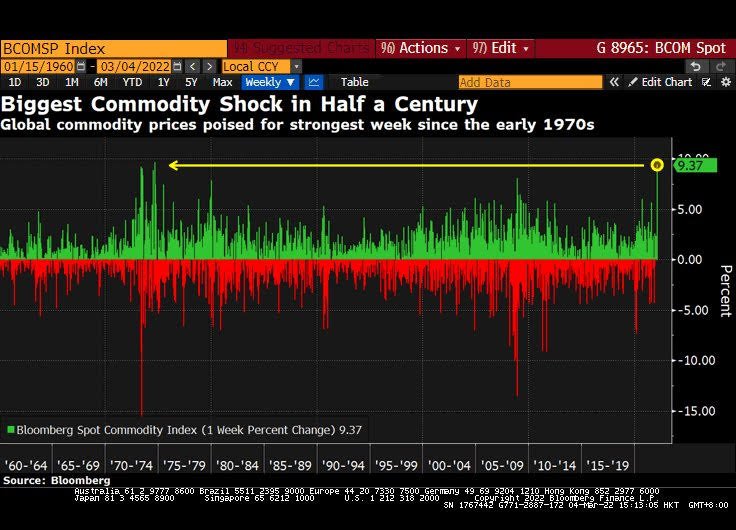
  • The Boom-Bust Cycle in Commodities Since the inception of the Bloomberg Commodities Index in 1991, it’s up a total of 24%. If you squint hard enough, you can see an annual return of just 0.7%. That’s not only worse than the 2.5% inflation rate in that time; it’s a lower return than you would have earned parking your money in cash. (Wealth of Common Sense)

Historical context on this commodity shock: The last time we had a week like this was closer to World War II.

Ukraine War, Russia's Economy, and the Economic Sanctions

Monday morning news drop

  • Ukraine Warcasting Predictions, market accountability, pundit accountability. The first part of this post looks at various markets’ predictions of how the war will go from here (Zvi published something like this a few hours before I could, so this will mostly duplicate his work). The second part very briefly tries to evaluate which markets have been most accurate so far – though this is a topic which deserves at least paper-length treatment. The third part looks at which pundits deserve eternal glory for publicly making strong true predictions, and which pundits deserve . . . something else, for doing . . . other things. (Astral Codex Ten)

  • I marched in solidarity with Ukraine. Across from us, there was another 'Freedom Rally' There is privilege in thinking life-saving mandates infringe on our freedoms (CBC)

  • Five reasons the sanctions are working In lieu of a military response, Biden and his allies are waging economic war on Putin’s Russia. It’s not a close fight. (Full Stack Economics)

  • Weaponizing Finance: To Punish Putin, the World Turned Finance Into a Weapon of War Russia’s central bank became the main target on a front that could crater the country’s economy. (Businessweek)

  • Russian cyber attacks against US banks increasing The big US banks — JP Morgan, Citigroup, Bank of America, Goldman Sachs — are under constant attacks by cyber criminals looking to disrupt operations and steal client information. The usual suspects are most often located in Iran, China and, of course, Russia. (New York Post)

  • Russia’s Economic Stagnation in Five Charts Former vassal countries of the Soviet Union that joined the EU have left their neighbor in the economic dust. (Bloomberg)

  • War in the time of crypto In the Russia-Ukraine conflict, which side is crypto helping? Both. (Recode)

  • Putin No Longer Seems Like a Master of Disinformation In the Ukraine invasion, we are seeing that Russian influence has significant limits — and perhaps the unraveling of the myth of Putin’s mastery over global discourse. Whatever the military and geopolitical outcome in Ukraine, it’s already clear that Russia has suffered a public-relations catastrophe. Repudiation of the invasion has been swift, forceful and widespread. (New York Times)

  • Why does Putin have superfans among the US right wing? The Russian leader is an autocrat with a homophobic and misogynistic worldview. No wonder he is so admired… (The Guardian)

  • The Bond King’s Genius Was No Match for His Ego In an excerpt from her new book, Mary Childs, the co-host of NPR’s Planet Money, takes a close look at the rise and fall of billionaire investor Bill Gross. (Businessweek)

  • The Wolf of Main Street: The fastest-growing landlord in the U.S. Midwest, Monarch Investment and Management Group, used evictions to drive up rents during the pandemic (Bloomberg)

  • ESG and Alpha: Sales or Substance? Managers of ESG investments create false hope, oversell outperformance, and contribute to the delay of long-past-due regulatory action. (Institutional Investor)

  • Why we need to expand our crop menu Climate variability and extremes like floods, storms and droughts were a key driver of global hunger and malnutrition in 2021. The proportion of low- and middle-income countries exposed to climate extremes has increased from 76% to 98% between 2000 and 2020, according to the UN Food and Agriculture Organization. (BBC)

  • A Tale of Two Buds: The Centuries-Old Feud Between American Budweiser and Czech Budweiser There are actually a couple of different Budweisers — the American version and the Czech version that inspired it. But the world is clearly not big enough for the both of them as they’ve been fighting over the name for more than 100 years (Mel)

  • The Bands Are Never Coming Back The era of group collectives dominating the charts has ended, probably forever—and it’s an issue much larger than just music. (The Honest Broker)

Videos of the Week, Prompt Payment, and Russia's Economic Collapse

Friday morning news drop

  • Alberta introduces prompt payment framework Provincial act sets out timelines and rules for payments and liens. (On-Site)

  • Russia’s Looming Economic Collapse This is terra incognita for economic policy. No country has ever faced this kind of global freeze-out. (The Atlantic)

  • Here’s What Happens When Investors Ignore Corruption “It’s a reminder that if you do business in countries without a rule of law, you could lose everything,” said Bill Browder. (Institutional Investor)

  • Biden And Allies Are Coming For Russian Billionaires’ Yachts: Forbes Tracked Down 32. Here’s Where To Find Them (Forbes)

  • Roman’s empire: how the seeds of Abramovich’s demise were there all along Almost 20 years after his high profile purchase, the oligarch is looking to sell Chelsea. Here’s the story of how it unraveled. Roman Abramovich has announced that he intends to sell Chelsea after almost 20 years of ownership, with net proceeds from the sale to be donated to "all victims of the war in Ukraine (Guardian)

  • What Happened in Ottawa? Separating the Discontent from the Darker Elements Tracing the protest’s growth, its symbols, and the troubling signs of hardening perspectives (Walrus)

  • A New Brand of Sticker Shock Hits the Car Market: With vehicles in short supply, prices are skyrocketing. Last month, 82% of new-car buyers paid more than sticker price. (Wall Street Journal)

  • The Radical Roots of Bikesharing: In mid-1960s Amsterdam, a counterculture movement with a small fleet of white bicycles pioneered a transportation model that’s swept thousands of cities around the world. (CityLab)

  • Just Steph Curry, Calmly Being Impossible Each shot drops cleanly over the exact front of the hoop and either gently grazes the back of the rim or touches nothing but the net. Curry punctuates this at the end by lofting a one-footed floater on a ludicrous parabolic arc from the free-throw line, as though throwing it over a squared-up brontosaurus; of course it goes in, and as cleanly as any of the others. (Defector)

Videos of the Week

Local Haunt: There’s something about just rolling out the door for a quick ride – squeezing in a couple hot laps before sundown, getting a jolt of adrenaline to cap off a day, or just being able to make the most of whatever found-time crops up. Norco Ambassador Sullivan “Sull” Reed’s local spot on the outskirts of Vancouver is just that. But with so much time spent lurking the loam, he started seeing trails that weren’t even there. To exhume these hidden lines, he hoofed his way deep into the suburban woods, rolled up his sleeves and put in the time to build the riding spot his spirit needed. Video: Max McCulloch.

Mike Mastroni - Industrial Eyes: It's been a good three years since we saw a fresh part from Sunday's Mike Mastroni, but that didn't mean he was sleeping! Since the completion of his Headlight's section, Mike has been out there bagging ultra creative clips on a variety of stand-out setups, and the result is well... incredible. 'Industrial Eyes' is the kind of part you can watch over and over and notice something new every viewing. This has to be one of our favourites in a long time.

CULTCREW/ JAUME/ 2022 “Last month I took a quick trip to LAX, being sent home the next day… I had this bcn piece started with my good friend Santi and took advantage of my longer stay to finish it.

Always try to make sum good out of the bad… “

UK Trails: 'STAFFS - Critical Cheese'

Volume Bikes - Victor Munoz in the Streets | DIG BMX

Bryce Wettstein's "Stereo" Part Bryce brings the good vibes and a unique bag of accessory-aided tricks to California’s bowls and big ramps.

HUGE NAZARE SWELL FEBRUARY 2022 | VON FROTH Injuries most of the tow teams have been swiped out including myself.. I was suppose to be out for the season due to a rib injury, but after seeing the Huge swell approaching Nazaré at 23ft at 21sec

Bank of Canada Hikes Key Interest Rate and the War on Ukraine

Thursday morning news drop

  • Bank of Canada hikes key interest rate to 0.5% More small rate hikes expected as central bank tries to rein in inflation (Bank of Canada)

  • TikTok Was Designed for War As Russia’s invasion of Ukraine plays out online, the platform’s design and algorithm prove ideal for the messiness of war—but a nightmare for the truth. (Wired)

  • Let’s Recall What Exactly Paul Manafort and Rudy Giuliani Were Doing in Ukraine President Trump’s former campaign chairman and former lawyer worked with, between them, a deposed authoritarian president, a bevy of oligarchs, Russia-oriented politicians and alleged Russian spies. (ProPublica)

    How Vladimir Putin Miscalculated the Economic Cost of Invading Ukraine The Russian leader apparently failed to anticipate the unprecedented targeting of the Central Bank of Russia, a step that has battered the ruble and shaken the country’s financial system. (New Yorker)

  • As Tanks Rolled Into Ukraine, So Did Malware. Then Microsoft Entered the War. After years of talks about the need for public-private partnerships to combat cyberattacks, the war in Ukraine is stress-testing the system. (New York Times)

  • Is the cyberwar coming or is it already here? Russia’s history of destructive cyberattacks in Ukraine is raising concerns about a cyberwar in the future. (Vox)

  • One Year, 14 Metrics: The State of Biden’s Presidency. Evaluating Biden’s first year in office through a series of metrics as our guide to the administration’s progress throughout his second year and beyond. (Bloomberg)'

  • BC Housing’s COVID-19 Response: Property Purchases BC Housing purchased nine properties in Vancouver and Victoria in 2020 and 2021 to provide temporary housing to people experiencing homelessness during the COVID-19 pandemic. The properties represented a significant public investment – totalling $221 million – that had to be secured quickly during the emergency. This audit examined whether BC Housing’s property purchases followed relevant approvals, policies and procedures. (Auditor General)

  • ‘Hard-partying bands are the outliers now’: how rock’n’roll broke up with booze and drugs (The Guardian)

  • Ian Bremmer on What Investors Should Know About Ukraine and Russia On this special episode of Live from the Compound, Ian Bremmer, President of Eurasia Group and GZERO Media, joins Josh Brown, Michael Batnick, and Ben Carlson to discuss how Russia's invasion of Ukraine could impact markets and the world economy. (YouTube)

Russian Invasion, Climate Change, and CM Punk

Wednesday morning news drop

  • A moment of clarity The Russian invasion of Ukraine should wake us up. Ukraine wasn’t threatening Russia in any way; Ukraine never fired a shot into their neighbor, even though that neighbor had already carved off pieces of their country in 2014 and subjected them to a grinding eight-year war. Putin simply declared that Ukraine is historically part of Russia and sent in his troops. (Noahpinion)

  • Is Taiwan Next? Russia’s invasion of Ukraine makes the frightening possibility of China seizing control of the island more real. (The Atlantic)

  • At 91, Warren Buffett Still Isn’t in Any Hurry: Lacking prospects for a new megadeal, he and longtime Berkshire Hathaway partner Charlie Munger are content to bide their time sitting on a massive pile of cash. (Bloomberg)

  • How Ikea tricks you into buying more stuff The home furnishings giant enlists a maze-like layout, cheap food, and crafty psychology to get you to fill up your cart. (The Hustle)

  • Sea Level Rise Will Be Catastrophic—and Unequal: A chilling new report predicts a foot of sea level rise in the US by 2050. But quirks of physics mean everyone will suffer in different ways. (Wired)

  • Climate change is killing people, but there’s still time to reverse the damage Heat waves, droughts, floods, wildfires, disease outbreaks and other dire effects of climate change are accelerating more rapidly than scientists expected in many parts of the world, including in North America. And as oceans, rainforests and polar regions heat up, nature is less and less able to help us with the task of adapting to a hotter Earth. (NPR)

  • A Nineteenth-Century Flu Pandemic May Be a Window into Coronaviruses Experts have turned back the clock to see what the Russian flu and other epidemics can teach us. (Walrus)

  • The Fall and Rise of CM Punk Nearly a decade ago, he walked away from pro wrestling and swore never to return. Now he's back, headlining All Elite Wrestling, a new league that's challenging the mighty WWE for dominance. Where did CM Punk go, and how did he get here? (Esquire)

Ukraine, Russia, and the Stock Market

Monday morning news drop

  • The ruble crashes, the stock market closes and Russia’s economy staggers under sanctions. The ruble cratered, the stock market froze and the public rushed to withdraw cash on Monday as Western sanctions kicked in and Russia awoke to uncertainty and fear over the rapidly spreading repercussions of President Vladimir V. Putin’s invasion of Ukraine. (New York Times)

  • In Ukraine, Daily Life in the Face of War Through years of conflict, people in eastern Ukraine have sought a semblance of normal existence—one that’s now under siege. (New Yorker)

  • The West Weaponizes Russia’s Central Bank Against Putin The sanctions have the potential to devastate the country’s economy and sow the seeds of Putin’s downfall. (Bloomberg)

  • Talks to end fighting between Russia and Ukraine end with no substantial agreement Exodus from Ukraine continues while sanctions have an impact on Russian economy (CBC)

  • The big sanctions: A quick explainer Western countries are now pulling out all the stops in terms of sanctions. The latest round includes: Cutting some Russian banks out of the SWIFT messaging system, Freezing the Russian central bank’s access to its foreign currency reserves held in the West, Increased sanctions on Russian banks in general, Establishing an international task force to hunt down and freeze the assets of Russian companies and Russian oligarchs Just a couple of days ago, these sanctions were almost unthinkable. But the moral clarity of the unprovoked and brutal Russian assault has changed minds (Noahpinion)

  • Big Tech’s Russia problem Social media companies are in a standoff with Russia on censorship and there’s no easy solution. (Recode)

  • Cryptocurrency Is a Potential New Tool for Billionaires to Avoid Sanctions Individuals and other entities targeted in the wake of Russia’s invasion of Ukraine may circumvent penalties if they choose to use crypto. (Bloomberg)

  • The Stock Market is Heartless It seems odd to worry about the stock market at a time of war when people are dying, losing their homes and potentially the country they love. The point here is the stock market is heartless. It often goes up in the face of godawful events when it almost doesn’t seem right. (A Wealth of Common Sense)

  • Berkshire Hathaway Rebounds From the Pandemic In announcing the company’s $90 billion profit in 2021, Warren Buffett noted the role that Berkshire plays in the American economy. (Dealbook)